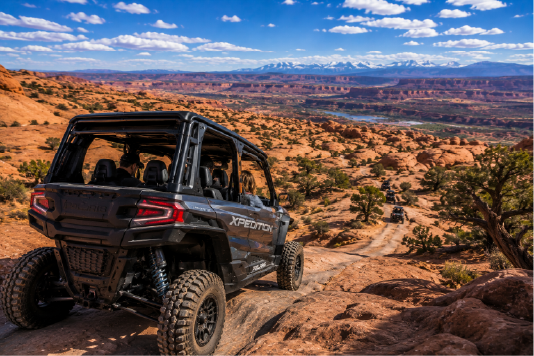
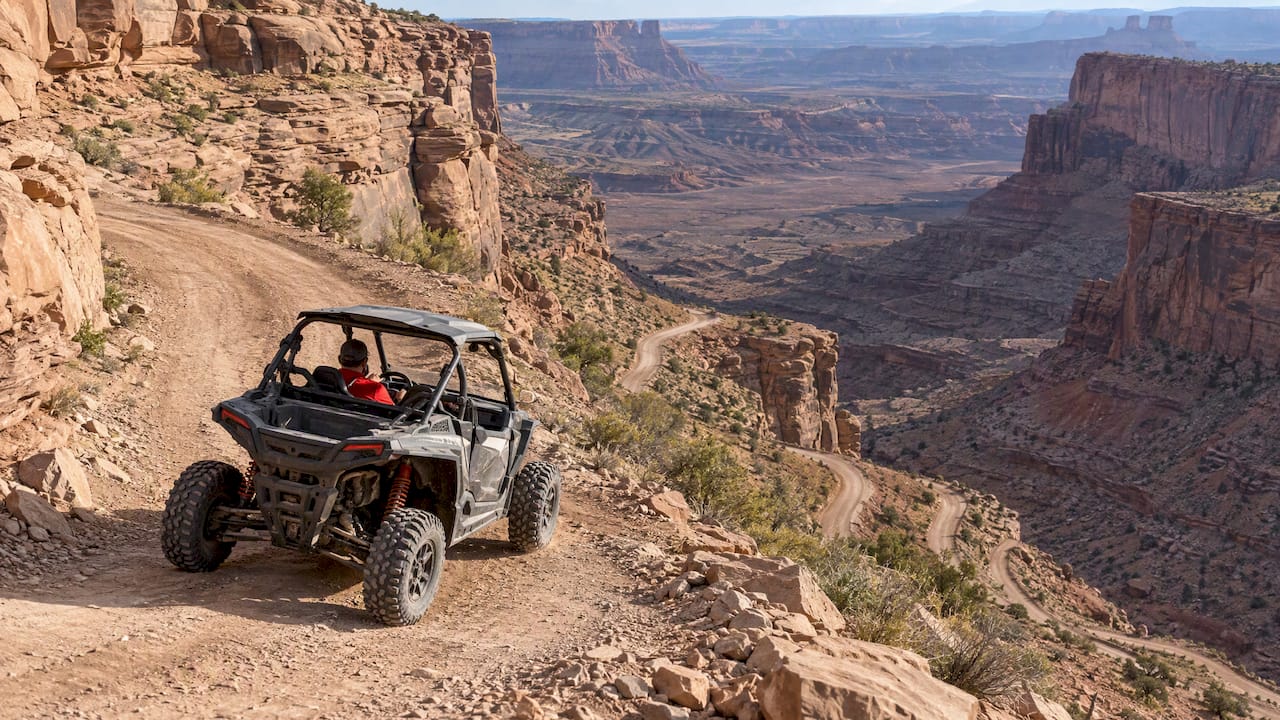
Trail guides for Hell's Revenge tend to read like liability waivers. Steep drops. Exposed ledges. Not for the faint of heart. Here's what actually describes the experience for the thousands of guests who complete this trail every season: it's one of the most photogenic, technically engaging, and visually spectacular trails in Moab — and in the right vehicle, with a proper briefing, it is well within reach of most capable adults. What the warning-heavy guides skip is the part where you understand what each section actually involves and what the vehicle underneath you is designed to handle.
What Hell's Revenge Is, in Plain Terms
Hell's Revenge is a 6.6-mile off-highway trail beginning near the Sand Flats Recreation Area east of Moab. The terrain is predominantly Navajo sandstone slickrock — the smooth, domed, red-orange rock formation that defines Moab's visual identity. The trail climbs and descends across this slickrock, passes through several technical obstacle sections, and rewards the effort with panoramic views over the Colorado River corridor, the La Sal Mountains, and the full sweep of canyon country to the south and west.
The trail has a reputation because it has genuine technical sections. It also has that reputation because it's been heavily documented on social media at its most dramatic angles, which consistently omit how approachable those same sections are from inside a capable vehicle with a guide who's run them hundreds of times.
Section by Section: What You'll Actually Encounter
The Entry and Early Slickrock
The first portion of the trail is an orientation in how slickrock driving works. The grippy friction coefficient of dry sandstone is the first thing most guests notice: you can hold angles and traverse slopes that would be impossible on any other surface. The early sections build that intuition before the technical features begin. The guide explains each upcoming obstacle before you reach it — you know what you're approaching, not just what it looks like after you're already committed.
The Water Pocket Obstacles
The water pockets are depressions in the slickrock — some shallow, some several feet deep — that require precise line selection to traverse cleanly. In the XP5 and Pro R, both of which carry sufficient ground clearance and suspension travel for these features, the section is technically demanding but not aggressive. The guide vehicle leads through each line. Your job is to follow that line; the vehicle's job is to handle the geometry of the obstacle.
Hell's Gate
Hell's Gate is the most-photographed section of the trail and the source of most of the dramatic imagery that circulates online. It's a descending sandstone ramp with exposure on both sides — a genuine commitment once you're past the entry point. The guide leads through first. You follow. The angle looks more severe from outside the vehicle than it feels from the driver's seat, which is something nearly every guest comments on after completing it. The briefing you receive before this section is specific and detailed — you'll know exactly what line you're taking before you move.
The Escalator
The Escalator is a steep, narrow channel cut into the slickrock — ascending rather than descending, which surprises some guests who expect the climbs to feel more exposed than the descents. In practice, the Xpedition and Pro R handle the Escalator with sufficient power and traction that the sensation is more impressive than threatening. The views from the top of the climb across the Moab valley are among the best on the trail.
The Summit Plateaus and Return Views
The trail's upper sections open into broad slickrock plateaus with unobstructed views in every direction. This is where photography happens, where the scale of the Colorado Plateau becomes tangible, and where the drive shifts from technically focused to genuinely awe-producing. The return route varies from the outbound line, covering different terrain and different angles on the canyon geography.
Vehicle Choice on Hell's Revenge
Epic 4x4 Adventures runs Hell's Revenge with two platforms, and the difference matters. The Polaris RZR Pro R is the performance-optimized choice: 225 horsepower, maximum suspension travel, built specifically for the kind of aggressive technical driving that Hell's Revenge rewards at speed. The Hell's Revenge Pro R Ultimate Experience is an adults-only (21+) tour designed for guests who want maximum capability and trail aggression.
The Polaris Xpedition XP5 Northstar runs Hell's Revenge with the enclosed, climate-controlled cab and stadium seating intact — capable on every trail feature at a pace appropriate for groups that prioritize comfort and accessibility alongside the technical experience. The Gateway to Hell's Revenge and Fins & Things tour runs the XP5 and is appropriate for mixed groups including families.
Why the Guided Caravan Format Changes the Experience
Self-guided off-road on Hell's Revenge is legal and common. It also means navigating trail features without prior knowledge of line selection, without a lead vehicle to follow through technical obstacles, and without radio support if something happens. The guide-led caravan format runs your group's vehicle behind a guide who knows every feature of the trail. You drive. The guide leads. The combination produces the confidence and spatial awareness to handle the trail correctly, not the anxiety of navigating it blind.
Seasonal Notes for Hell's Revenge
The trail is accessible year-round in typical conditions. Spring (March–May) offers the best light and temperatures. Summer tours in the XP5 Northstar are fully viable due to the enclosed climate-controlled cab; open-cockpit vehicles on summer afternoon tours on slickrock can be genuinely uncomfortable due to heat absorption off the rock surface. Fall (September–November) offers similar conditions to spring with warmer midday temperatures. Check Sand Flats Recreation Area conditions before any winter visit — ice on slickrock creates a fundamentally different trail than the dry-season version.
Frequently Asked Questions
How difficult is Hell's Revenge compared to other Moab trails?
Hell's Revenge is rated moderately difficult to difficult. Its reputation for challenge comes primarily from a few specific technical sections — Hell's Gate and the Escalator in particular — that require precise line selection and commitment. In a guided format with a capable vehicle, the difficulty is well-managed. It is more technically demanding than the Moab Discovery Tour and roughly comparable in intensity to Fins & Things.
Is Hell's Revenge appropriate for first-time off-road guests?
Yes, with the right context. First-timers on the Gateway to Hell's Revenge and Fins & Things tour complete the trail regularly. The guide briefing before each technical section, the guide-led caravan format, and the capable vehicles make it accessible without requiring prior experience. If you're uncertain whether it's the right starting point, the Moab Discovery Tour is a lower-commitment introduction to Moab slickrock.
How long does a Hell's Revenge UTV tour take?
The Gateway to Hell's Revenge and Fins & Things tour runs approximately a half day, including the pre-departure briefing at the trailhead. Total time varies with group pace and stop frequency for photographs. Plan for a committed morning or afternoon block, not a quick two-hour experience.
What's the best time of day to run Hell's Revenge?
Morning tours offer cooler rock surface temperatures and better light for photography from the upper trail sections. Afternoon summer light can be harsh on the slickrock and in the canyon; morning is preferred for comfort and visual conditions. In spring and fall, either morning or afternoon works well.
Ready to see Hell's Revenge for yourself? View the Gateway to Hell's Revenge and Fins & Things tour or the Pro R Ultimate Experience — or contact us to find the right fit for your group.