Meta Title: Jeep vs. UTV in Moab | Choosing the Right Off-Road Vehicle Meta Description: Deciding between a Jeep and a UTV for Moab? Here's an honest comparison of capability, comfort, ease of driving, and what each does best on the trail. Slug: /blog/jeep-vs-utv-moab Primary Keyword: Jeep vs UTV Moab Word Count Target: ~1,800
Moab is one of the few places on earth where both Jeep Wranglers and UTVs can access the same trails. That creates an honest question for visitors: which vehicle should you choose?
Both are capable. Both are fun. But they're built for different things, and the right choice depends on what kind of day you want to have on the trail.
The Core Difference: Road Vehicle vs. Trail Vehicle
A Jeep Wrangler Rubicon is a road vehicle engineered to handle trails. It drives to the trailhead on the highway, then transitions to off-road terrain. That versatility is its strength. One vehicle, all-day use, pavement to slickrock and back.
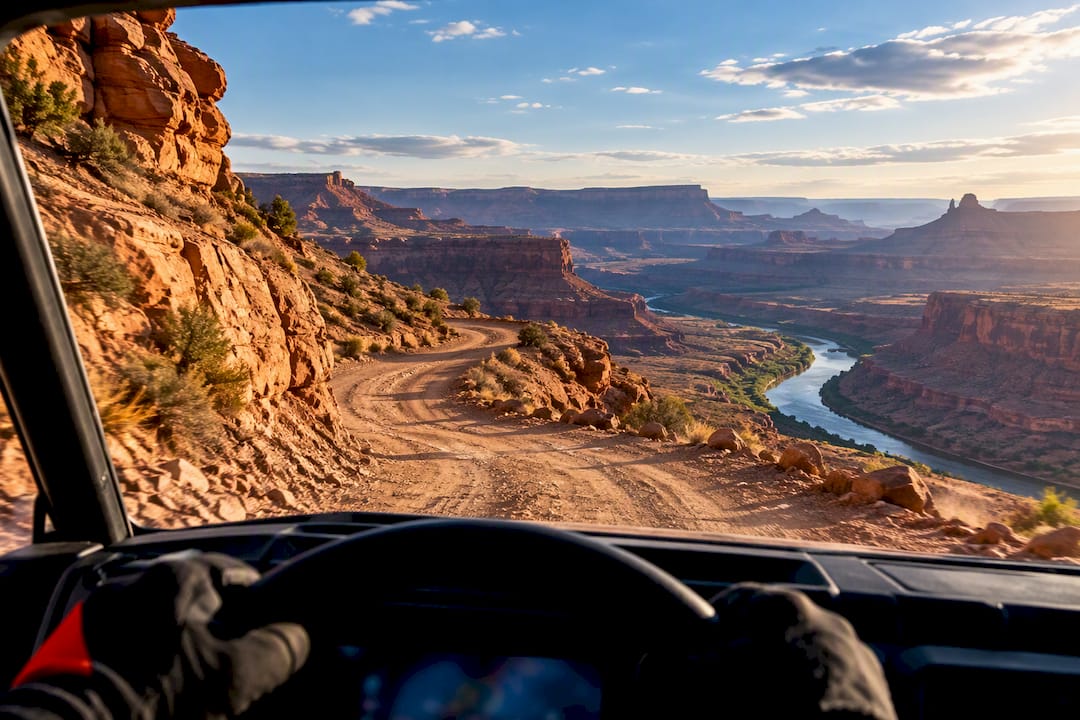
A UTV like the Polaris RZR is a trail-specific machine. It exists for one purpose: off-road performance. Everything about it, the suspension geometry, the power-to-weight ratio, the low center of gravity, is designed for exactly the kind of terrain Moab is known for.
That's not a knock on the Jeep. It's a recognition that purpose-built equipment tends to outperform multi-purpose equipment in its specific domain. A Jeep can do what a UTV does. A UTV does it with less effort.
How Do They Compare on the Trail?
Factor
Jeep Wrangler Rubicon
Polaris RZR Pro R
Designed for
Road and trail
Trail-specific off-road
Suspension travel
~10 inches
29 inches
Harness type
Lap and shoulder seatbelt
Six-point harness
Climate control
Open air or soft top
Enclosed cabin options, heated seats
Trail navigation
Paper map or personal GPS
Built-in navigation with preloaded trails
Insurance for rentals
Personal auto insurance required
Adventure Assure included, no personal policy needed
Damage deposit
Varies ($500-$2,500 typical)
$0 option available
Learning curve
Higher (larger vehicle, manual shifting)
Lower (automatic, intuitive controls)
Best for
Highway driving + moderate trail access
Dedicated off-road terrain, slickrock, technical features
.jpg)
What Does 29 Inches of Suspension Travel Actually Feel Like?
This is the number that matters most on Moab's terrain, and it's where the two vehicles diverge sharply.
A Rubicon's ~10 inches of suspension travel means you feel the trail. Every ledge, every rock, every washboard section transfers through the chassis and into the seat. That's part of the Jeep experience for many people, and there's nothing wrong with it. But over 3-4 hours on technical terrain, it adds up. Your back feels it. Your hands feel it. Your passengers feel it.
The RZR Pro R's 29 inches of travel absorbs terrain that would rattle a Jeep. The same rocky section that requires careful line selection in a Wrangler is something the RZR floats over. You're still engaging with the trail. You're still making driving decisions. But the vehicle is doing more of the physical work, so you can focus on the landscape rather than gripping the steering wheel.
Which Vehicle Is Easier to Drive in Moab?
For visitors who don't off-road regularly, this is often the deciding factor.
Jeeps are wider and heavier, and require greater spatial awareness on narrow shelf roads. Many Moab Jeep rentals are manual transmission, which adds a layer of complexity on steep inclines. Turning radius matters on switchbacks. And the elevated driving position, while great for visibility, can make steep descents feel more exposed than they actually are.
UTVs sit lower, respond faster, and use automatic transmissions. The steering is lighter. The vehicle's width is more forgiving on most trails. And because the driver is closer to the ground, the perception of exposure on ledges and drop-offs is less intense.
None of this means a Jeep is dangerous or unmanageable. It means a UTV has a shorter learning curve, which matters when you're on a trail you've never seen before.
What About the Rental Process?
This is where the practical differences stack up quickly.
Most Jeep rental outfits in Moab require proof of personal auto insurance that covers you in a rental vehicle. Credit card insurance doesn't qualify. If your personal policy doesn't extend to rental off-road vehicles (many don't), you may need to purchase supplemental coverage before you even pick up the keys. Damage deposits typically range from $500 to $2,500, depending on the operator.
Our UTV rentals include Adventure Assure rider protection. That covers driver liability, $25,000 in accident medical for every rider, and damage protection. No personal auto insurance required. And with our $0 damage deposit option, there's no large hold on your credit card tying up vacation funds. More details on how this works are in our FAQ.
Every vehicle in our fleet also comes with built-in navigation and preloaded trail routes. You get turn-by-turn guidance, trail tips, overlook markers, and areas-of-concern alerts loaded directly into the vehicle's display. No squinting at a photocopied paper map. No pulling out your phone on the trail.
When a Jeep Might Be the Better Call
If your plans involve long stretches of highway between destinations, a Jeep gives you one vehicle for the full day. You can drive to Arches National Park in the morning, hit a trail in the afternoon, and cruise back to your hotel on the highway without towing anything.
If you already own a Jeep and know how it handles, renting a similar vehicle in Moab means no learning curve at all.
And if your priority is the iconic look of a Wrangler on slickrock, that's a valid reason on its own. Moab and Jeeps have a long shared history.
For the scenic highway portion of a Moab trip, though, our Polaris Slingshot is worth a look. It's built for pavement, seats two, starts at $199, and the open-air design makes the drive to Dead Horse Point or through the Arches scenic road feel like its own separate adventure.
What If I'd Rather Not Drive at All?
Fair question. Not everyone wants to be behind the wheel on unfamiliar terrain.
Our guided tours pair you with a professional guide who knows every feature, every obstacle, and every overlook on the trail. You still drive on our you-drive tours. You just have someone in front of you showing the way and talking you through the tricky parts over the radio.
The Pro Xperience Tour is our fully custom, we-drive option. You ride. The guide drives. No decisions required except where to point the camera.
Frequently Asked Questions
Do I need a Jeep for Hell's Revenge? No. UTVs handle Hell's Revenge as well or better than Jeeps, thanks to superior suspension travel and a lower center of gravity. Our Hell's Revenge Pro R tour is one of the most popular ways to experience the trail.
Can a UTV go anywhere a Jeep can in Moab? On off-road trails, yes. UTVs are street legal in Moab on roads posted 55 mph and under, so you can drive to most trailheads. For longer highway stretches, trailers are available.
Which is safer, a Jeep or a UTV? Both are safe when operated properly. UTVs in our fleet include six-point harnesses, roll cages, and Adventure Assure rider protections, including $25,000 medical coverage per rider. Most Jeep rentals use standard seatbelts.
Should I rent a UTV or book a guided tour? If you've never off-roaded in Moab, a guided tour removes the guesswork. If you're experienced and want to explore on your own schedule, a self-guided rental with built-in navigation gives you full flexibility.