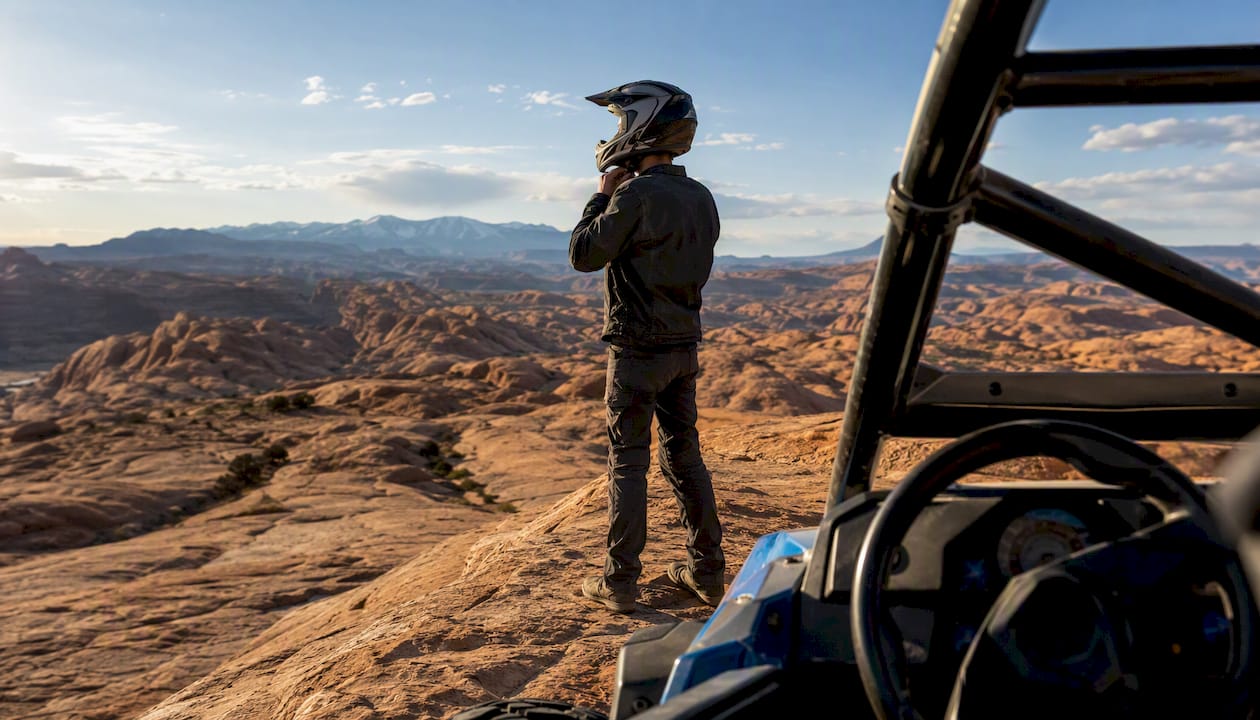
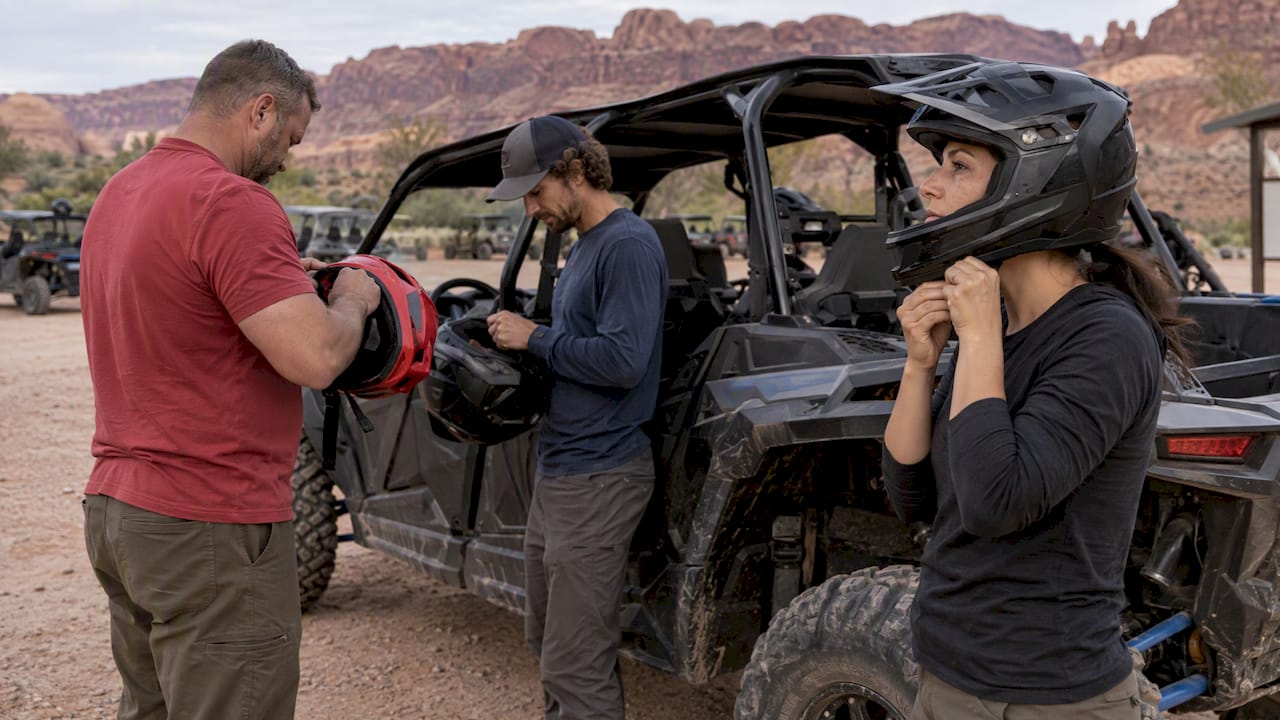
Choose a 1-, 2-, or 3-day sample itinerary below. Each one lists exact start times, trail order, and the permits or registration you need before you ride. The short version: a 1-day trip pairs Fins & Things as a warmup with a Hell’s Revenge sunset run. A 2-day trip adds Shafer Trail or Poison Spider for scenic variety. A 3-day trip works in a Canyonlands scenic drive plus a second full trail day. Before any of it, confirm your Utah OHV registration and review Moab’s city OHV rules so you’re not sorting out paperwork at the trailhead. Epic4x4adventures runs guided versions of nearly every route below.
- 1 day: Fins & Things (AM) → Hell’s Revenge (PM/sunset)
- 2 days: Day 1 Hell’s Revenge, Day 2 Shafer Trail or Poison Spider
- 3 days: Add a Canyonlands scenic drive and a second full trail day (Kane Creek or Gemini Bridges)
TL;DR:
- Confirm Utah OHV registration and ensure your vehicle meets Moab’s noise restrictions before heading to the trails.
- Ride Fins & Things early in the day and schedule Hell’s Revenge at sunset to avoid peak traffic and maximize scenic views.
- Allocate extra time for photo stops, vehicle swaps, and breaks on longer or more complex trail loops, especially for larger groups.
- Pack essential safety gear, including water, a tow strap, basic tools, and a satellite messenger for remote sections; check brakes and tire pressure beforehand.
- Booking guided tours with Epic4x4adventures provides reliable routes, built-in navigation, and tailored experiences for any trip length.
Table of Contents
- Sample 1-, 2-, and 3-Day Moab UTV Itinerary Plans
- Building a 4-Day or Longer Moab UTV Loop
- Which Moab Trails Fit Which Day of Your Trip
- Utah OHV Registration and Moab’s Street-Legal Rules
- What to Pack and Check Before You Ride
- When Should You Plan Your Moab UTV Trip?
- Let Epic4x4adventures Run Your Itinerary for You
- Editorial Take: What Actually Makes a Moab UTV Itinerary Work
- Book Your Moab UTV Itinerary With a Local Team
- Key Takeaways
- Sources
Sample 1-, 2-, and 3-Day Moab UTV Itinerary Plans
If you’ve only got one day, don’t waste it driving between trailheads. Start at 9:00 AM at Sand Flats Recreation Area with the Fins & Things loop, a slickrock warmup that takes roughly two to two and a half hours. Grab lunch back in town by 12:30, refuel, and reset for the main event: Hell’s Revenge at 2:30 PM, timed so your sunset climb up the exposed slickrock ridges hits around 6:30 to 7:00 PM depending on the season. Build in a 30-minute buffer for Sand Flats traffic, which peaks on weekends.
For a 2-day itinerary, spread the intensity out. Day one starts at 9:00 AM with Hell’s Revenge, finishing by early afternoon with time for lunch and a slower second loop if your group has energy left. Day two opens at 8:30 AM with either Shafer Trail (better for photography and switchback views) or Poison Spider (better for technical obstacles and rock crawling). Both take four to five hours round trip with stops.
Three days gives you room to actually see the parks, not just the dirt between them:
- Day 1: Hell’s Revenge, 9:00 AM start, finish by 2:00 PM
- Day 2: Poison Spider or Kane Creek Canyon, full day, 8:30 AM to 3:30 PM
- Day 3: Canyonlands scenic drive (no OHVs permitted on park roadways, so this is a separate vehicle) plus a shorter recovery-day trail like Gemini Bridges
To shorten any plan, drop the second trail loop and treat day one as your only full-intensity day. To extend it for larger groups or newer riders, add 45 to 60 minutes per stop for photo breaks and vehicle swaps, and consider splitting into two smaller convoys so pacing doesn’t stall behind your slowest driver.
Building a 4-Day or Longer Moab UTV Loop
A longer trip lets you stitch trails into a real loop instead of hopping between disconnected trailheads. A workable 4-day structure looks like this:
- Day 1: Poison Spider, staying near Moab that night
- Day 2: Golden Spike, a technical add-on often paired with Poison Spider access points
- Day 3: Shafer Trail with a detour toward the White Rim overlooks, planning six-plus hours of drive and trail time
- Day 4: Kane Creek Canyon or a repeat sunset run at Hell’s Revenge before heading out
For overnight logistics, most riders base out of Moab rather than camping trailside, since fuel, parts, and food are all within a few minutes of the major trailheads. If you do camp, check BLM access and current trail conditions before you commit to a remote stretch, since seasonal closures and washouts happen without much warning.
Pro Tip: Fuel up the night before each trail day, not the morning of. Gas stations near the main trailheads get backed up early, and losing 20 minutes in line throws off a whole day’s timing.
Remote sections like extended Poison Spider variants or anything approaching White Rim territory are where a guide earns its cost. Creek crossings, tricky exposure sections, and long stretches without cell service are a different risk category for a first-time group than an afternoon loop.
Which Moab Trails Fit Which Day of Your Trip
Hell’s Revenge is Moab’s signature trail for a reason: steep slickrock climbs and a mix of optional obstacles let you scale the difficulty up or down as you go. It’s also the most crowded trail in the area, especially near sunset, so if you’re avoiding traffic, ride it at 9:00 AM instead of the popular evening slot.
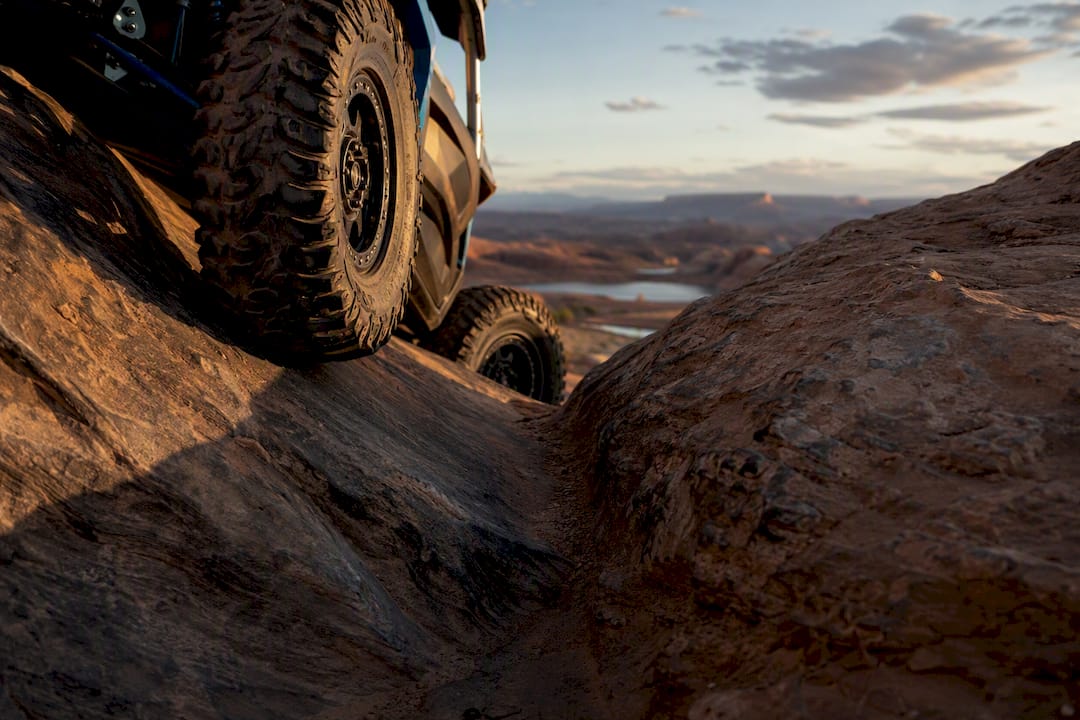
Fins & Things is the right warmup: a slickrock loop inside Sand Flats Recreation Area, which charges its own entry fee separate from any UTV rental cost. It suits beginner-to-intermediate riders who want exposure to slickrock without Hell’s Revenge-level commitment.
Shafer Trail is more scenic drive than technical challenge, with switchbacks carved into the canyon wall. Note that OHVs are not permitted on roadways inside Canyonlands National Park itself, so plan your route to stay on BLM land and approved access points.
A few more worth knowing:
- Poison Spider: rock ledges and moderate technical sections, a step up from Fins & Things
- Kane Creek Canyon: underrated for scenery, with creek crossings that get trickier after rain
- Gemini Bridges: moderate difficulty with a genuinely striking rock formation payoff at the end
Utah OHV Registration and Moab’s Street-Legal Rules
Before you touch a trail, your paperwork needs to be square. Utah requires OHV registration and an education course for riders, and non-residents need a separate permit if their home state doesn’t have a reciprocal agreement with Utah.
Inside Moab city limits, street-legal OHVs answer to local rules that surprise a lot of first-time visitors.
Moab enforces a strict speed limit on posted city streets for OHVs, and vehicles exceeding a certain noise threshold are banned outright on those streets. Vehicles with higher noise levels face additional night-time restrictions.
That noise rule matters more than most riders expect. If your rental or personal UTV has an aftermarket exhaust, confirm it’s compliant before you drive through town rather than trailer around it.
- Register your OHV and carry proof of Utah registration or a valid non-resident permit
- Keep speed at or under 15 mph on any posted Moab street
- Confirm your exhaust setup meets the dBA thresholds if you’re driving street-legal to a trailhead
- If your vehicle isn’t street-legal, trailer to the trailhead instead of risking a citation
What to Pack and Check Before You Ride
A solid pre-ride routine takes ten minutes and saves hours if something goes wrong 20 miles from pavement.
- Check brakes, lights, tire pressure, and fluid levels before leaving the lot
- Confirm you have a tow strap, basic tool kit, and a spare belt if your vehicle uses one
- Fill up fully. Fuel stops thin out fast the farther you get from Moab proper
- Pack water for every rider (more than you think you need), sun protection, and a layer for temperature swings
- Bring a basic first-aid kit and know your communication options. Cell service drops out on several trails, so a satellite messenger is worth it for remote days
Before you leave, assign roles within your group, set a turn-back time everyone agrees to, and leave your route plan with someone back in Moab.
Pro Tip: Text a friend or your hotel front desk your planned route and expected return time. It costs nothing and it’s the single easiest safety step riders skip.
When Should You Plan Your Moab UTV Trip?
Spring and fall are the strongest windows for Moab UTV riding, with daytime temperatures that let you ride comfortably from mid-morning through sunset. Summer trips are still doable, but plan an early start, ideally rolling out by 7:30 or 8:00 AM, to beat the heat on exposed slickrock. Winter closes some north-facing sections to ice, so confirm conditions ahead of time.
Time trails to their strengths: Hell’s Revenge shines at sunset, Fins & Things is best tackled early before the slickrock heats up, and creek crossings on Kane Creek are safer after a dry stretch rather than right after rain. Check current trail status through BLM or Sand Flats before you commit to a route.
Let Epic4x4adventures Run Your Itinerary for You
Every itinerary above can be booked instead of self-organized. Epic4x4adventures covers the sunset Hell’s Revenge slot, full-day multi-trail combinations, and guided multi-day options for groups who’d rather not manage logistics themselves.
The fleet is entirely 2026 Polaris vehicles with built-in navigation, so even a self-drive rental follows the route without guesswork. Add the optional $0 damage deposit, local guides who know exactly when Hell’s Revenge gets crowded, and over 4,700 five-star reviews behind the brand.
- Sunset Hell’s Revenge tours matching the 1-day itinerary’s evening slot
- Full-day multi-trail packages for 2- and 3-day plans
- Guided multi-day options for remote loops that need an experienced lead driver
Editorial Take: What Actually Makes a Moab UTV Itinerary Work
Most Moab content treats UTV riding as an afterthought to sightseeing. That’s backward. A trail itinerary built around what you’ll actually see from Delicate Arch parking lots doesn’t account for the fact that Hell’s Revenge at 9:00 AM and Hell’s Revenge at 6:30 PM are two completely different experiences, one crowded and flat-lit, the other quiet and dramatic.
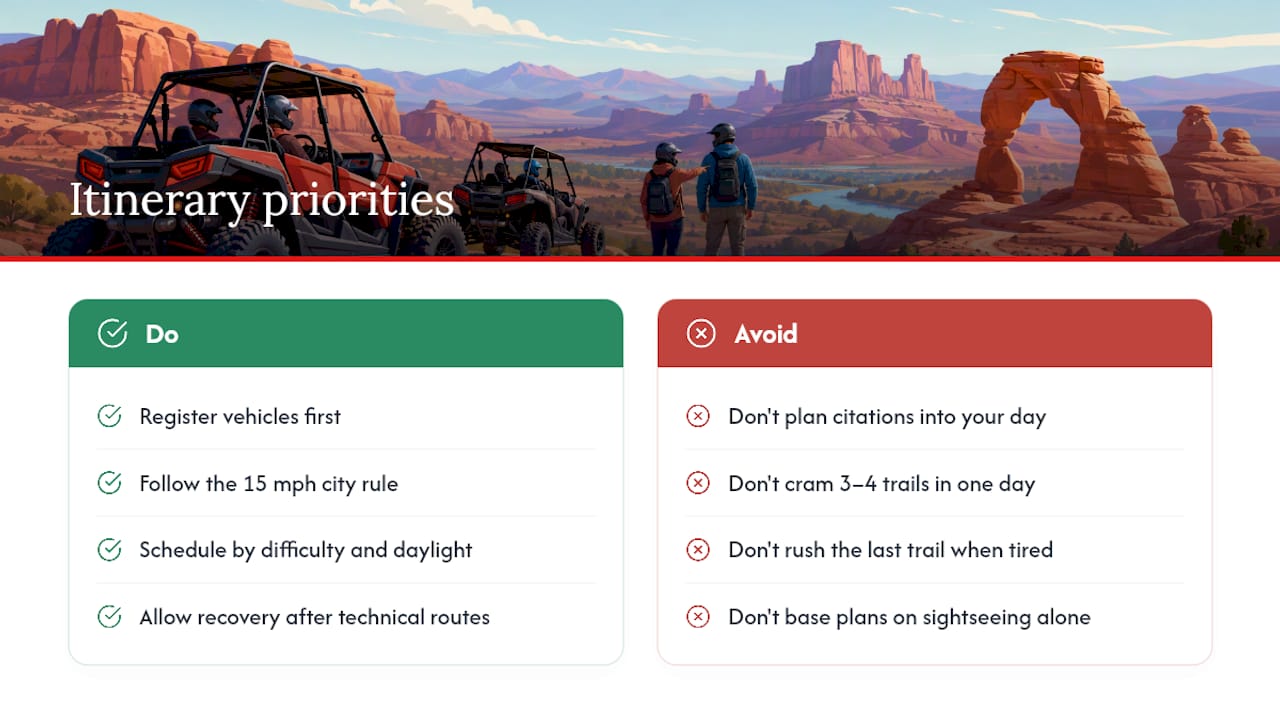
The conventional advice, cramming three or four trails into a single day, also undersells how much recovery time matters after a technical route like Poison Spider. Riders end up rushing the last trail of the day, which is exactly when fatigue causes mistakes.
What should you prioritize first? Registration and the 15 mph city rule, before trail selection. Nothing derails a carefully timed itinerary faster than a citation or a vehicle that can’t legally leave the lot. Get the legal groundwork settled, then build your schedule around trail difficulty and daylight, not the other way around.
— PHENYX
Book Your Moab UTV Itinerary With a Local Team
Epic4x4adventures is the direct alternative to spending your first Moab morning figuring out trail access, permits, and vehicle logistics on your own. Every rental comes on a 2026 Polaris with built-in GPS navigation already loaded with local routes, so the itinerary you just read maps onto a real vehicle without extra research.
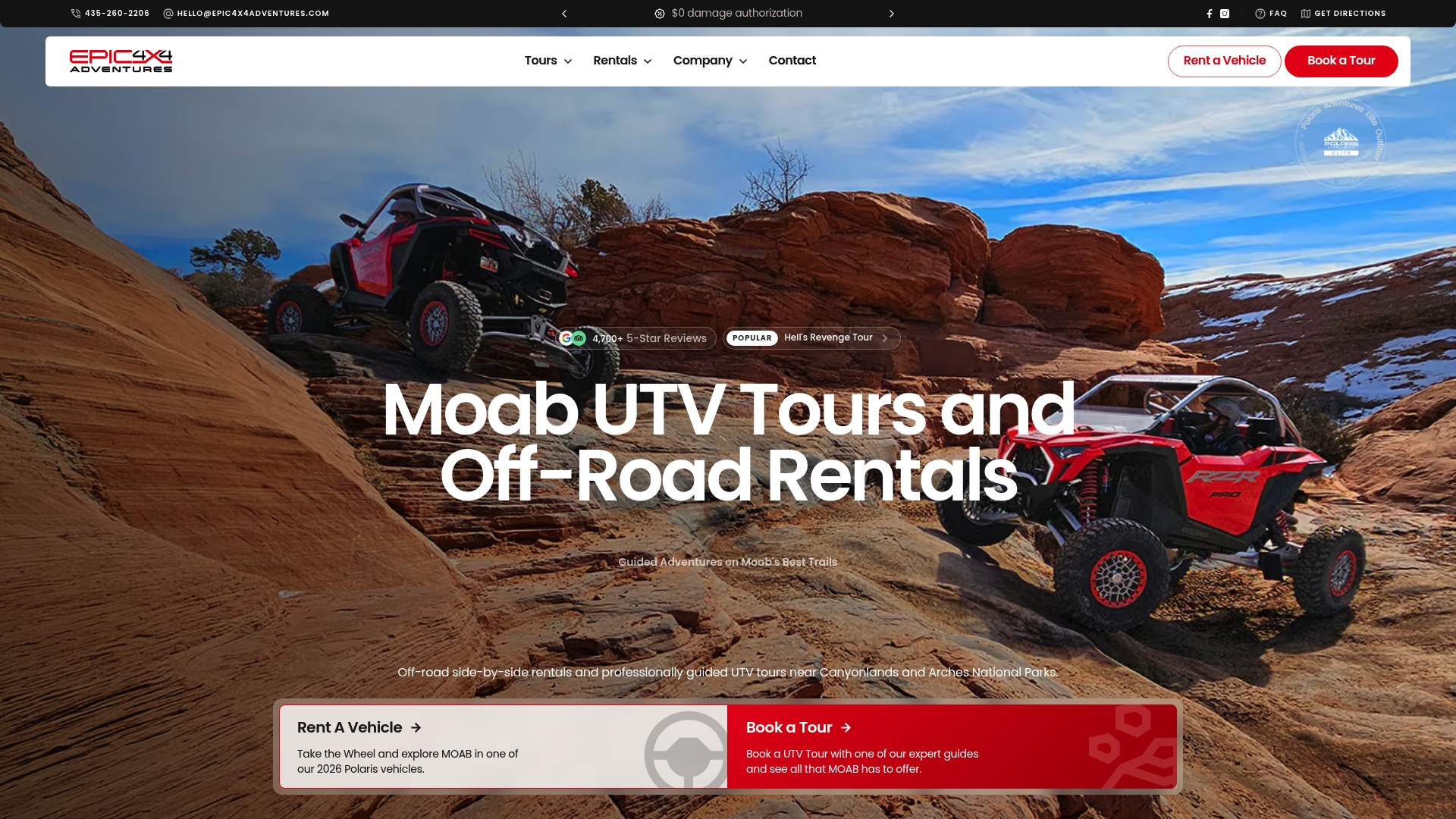
If you’d rather have someone else drive, the guided tour catalog covers everything from sunset Hell’s Revenge runs to full-day multi-trail combinations. If you want to drive yourself but skip the insurance headache, the $0 damage deposit option removes the biggest hesitation most first-time renters have. Planning a longer trip? Pair your UTV days with lodging and other things to do in the area for the nights in between. Check availability on the rentals page and lock in your dates before your preferred trail window fills up.
Key Takeaways
A successful Moab UTV itinerary starts with legal compliance, then matches trail difficulty and timing to trip length rather than cramming in every trail at once.
| Point | Details |
|---|---|
| Match trip length to trails | One day fits Fins & Things plus Hell’s Revenge; three days adds Canyonlands sightseeing and a second full trail day. |
| Confirm registration first | Utah OHV registration and Moab’s 15 mph city rule apply before you ever reach a trailhead. |
| Time trails by crowd and light | Ride Fins & Things early, save Hell’s Revenge for sunset when possible. |
| Pack for self-sufficiency | Bring water, a tow strap, tools, and a satellite messenger for remote sections. |
| Book guided execution | Epic4x4adventures offers 2026 Polaris rentals and guided tours matching every itinerary slot above. |
Sources
- OHVs In Moab — City of Moab
- OHV Laws & Rules — Utah Outdoor Recreation
- 10 Best off-road-driving trails in Moab — AllTrails
Recommended
- Zion to Moab: How to Build a Utah Road Trip That Actually Includes Off-Road Time | Epic 4x4
- Moab Rim Trail: The UTV Guide for Riders Who Want Views Without the Crowds | Epic 4x4
- Three Generations, One Trail: Planning the Perfect Multi-Generational Moab UTV Trip | Epic 4x4
- Plan a guided UTV You-Drive Tour in Moab. | Epic 4x4