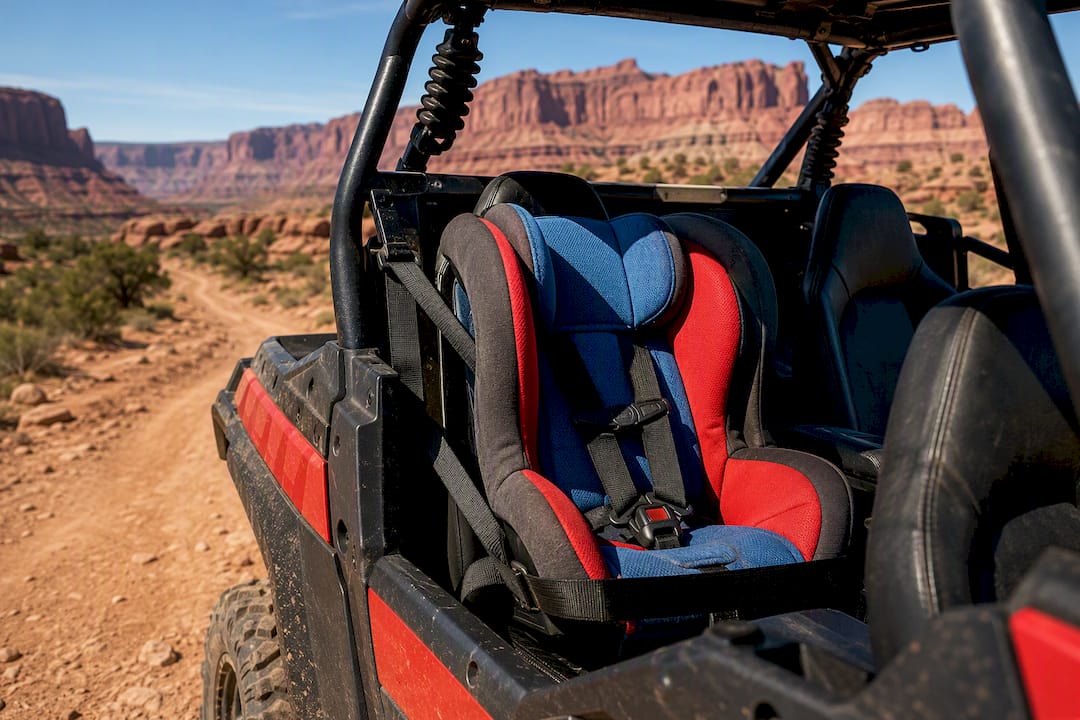
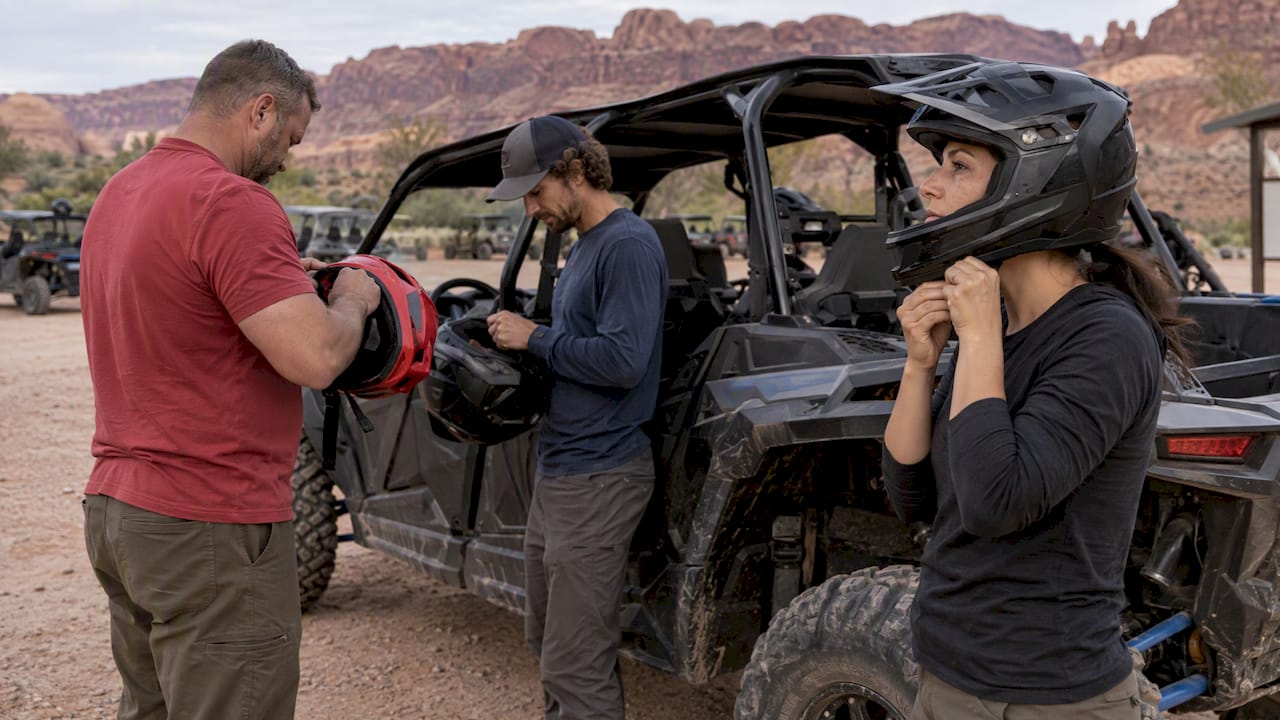
Yes, a car seat can go in a UTV in Moab, but only when it can be installed according to the manufacturer’s instructions and the seat stays stable once it’s in place. That is the whole answer, and it comes with one caveat that matters more than anything else on this page: most UTVs weren’t built with LATCH anchors or the same seat geometry as a minivan, so a seat that clicks in perfectly at home may not click in at all on a Polaris bench seat.
Two things to do before you show up:
- Bring your own car seat and arrive early. Installation on an unfamiliar seat shape takes longer than you think.
- Book with a family-friendly operator that offers installation help, so you’re not troubleshooting straps in a parking lot with kids waiting.
Key Takeaways
A car seat can ride safely in a Moab UTV only when the manufacturer’s installation instructions are followed exactly and the seat shows no more than an inch of movement once buckled in.
| Point | Details |
|---|---|
| Verdict on car seats | Car seats can work in UTVs, but only with a correct manufacturer-approved install and a stable seat. |
| Utah law applies to roads | Under-8 requires a child restraint and 8 to 15 requires a seat belt on public roads under Utah Code 41-6a-1803. |
| No specific UTV car seat law | Utah’s OHV guidance leaves restraint choices on trails to operator judgment. |
| Fit issues are common | Narrow bucket seats and missing LATCH anchors are the most frequent installation obstacles. |
| Ask before you book | Confirm installation help, seating layout, insurance, and family trail options in one call. |
Table of Contents
- Utah Rules That Matter for Kids in UTVs
- Will Your Car Seat Actually Fit the UTV?
- How to Secure a Child in a UTV, Step by Step
- What to Ask Before You Book With Kids
- Why Epic4x4adventures Fits the Family-Ready Checklist
- Does Requesting Child Safety Help Cost More?
- Where to Book a Family-Friendly UTV Trip in Moab
- The Real Gap in Most UTV Safety Advice
- Sources
Utah Rules That Matter for Kids in UTVs
Utah’s child restraint law, Utah Code 41-6a-1803, requires children under age 8 to ride in a child restraint device used according to the manufacturer’s instructions. Kids age 8 through 15 need a seat belt. There’s one exception worth knowing: a child under 8 who is already 57 inches tall is exempt from the car seat requirement and only needs a seat belt.
That statute governs motor vehicles on public roads. UTVs occupy different territory. Utah’s Division of Outdoor Recreation states plainly that there are no state laws requiring car seats or helmets specifically for UTVs. The guidance recommends proper headgear and appropriate restraints, but the final call rests with the operator.
Quick fact: A child-restraint violation in Utah is an infraction with a maximum fine around $45, and courts sometimes waive it for first-time offenders who later show proof of a child restraint. That penalty structure tells you something important: the fine is nowhere near the real risk. The law is a floor, not a safety plan.
So how does this apply on a trail near Arches or Canyonlands? A few distinctions:
- On paved roads to and from the trailhead, the standard child-restraint statute applies.
- On designated OHV trails, Utah treats UTVs under separate recreational vehicle rules, detailed in the state’s OHV law highlights brochure, which covers vehicle classifications and registration rather than child seating specifics.
- Regardless of which rule technically applies, the manufacturer’s instructions for your car seat function as the practical standard everywhere you use it.
Will Your Car Seat Actually Fit the UTV?
This is where most parents run into surprises. A car seat that’s rock solid in a sedan can wobble, tilt, or refuse to buckle at all in a UTV, and the reasons are mechanical, not about the law.
Common fit problems:
- Narrow bucket seats. Many UTV seats are bucket-style and molded for an adult torso, which leaves less lateral support for a car seat base than a flat bench seat would.
- Curved bench seats. Some UTVs use a bench in the rear row, but the cushion often slopes or curves, which can rock a rear-facing base instead of holding it flat.
- No LATCH anchors. UTVs typically skip the LATCH hardware you’d find in a passenger car, so the seat belt has to do all the work.
- Seat belt routing conflicts. Some UTV belts run at angles or attach to points that weren’t designed with a car seat’s belt path in mind, which can leave the seat loose even when the belt feels tight.
Different seat types behave differently once you’re in the vehicle. Rear-facing infant seats depend entirely on base stability, so if the bench cushion isn’t flat, the base can rock even with the belt cinched down. Convertible forward-facing harness seats need a clean belt path across the frame, and a misrouted belt can pull the seat sideways instead of pinning it down. Boosters are the most forgiving of the three, since they mainly need the adult belt to sit correctly across the child’s hips and shoulder, but that only works if the UTV’s belt geometry matches the booster’s design.
Before you book, run through this short checklist: measure your seat’s width and depth against the UTV’s seating dimensions if the rental company can share them, bring the seat’s manual so an installer can follow your exact model’s instructions, ask about the belt path in the seat you’ll be assigned, and only bring a locking clip or extra strap if your car seat’s manufacturer explicitly permits one. Improvised hardware that isn’t approved for your specific seat can undo the protection the seat was designed to provide.
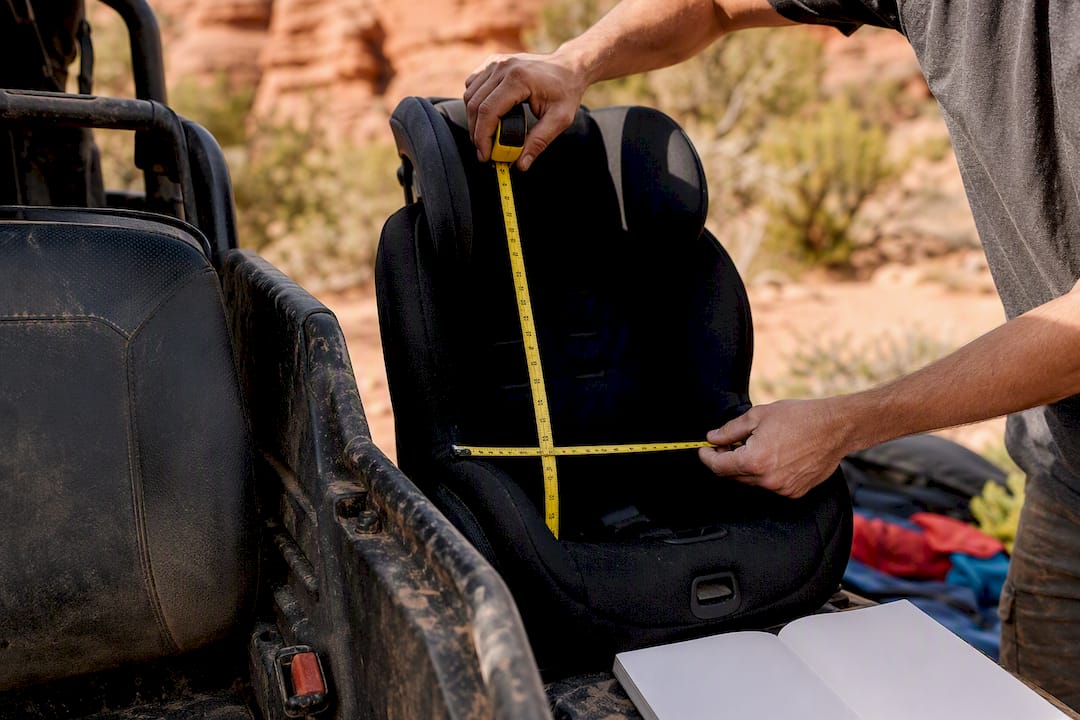
Pro Tip: Call ahead and describe your exact car seat model, rear-facing infant, convertible, or booster, so staff can tell you in advance whether that seat has worked in their fleet before. A five-minute phone call beats a stressful ten minutes in the parking lot.
How to Secure a Child in a UTV, Step by Step
Once you know your seat can physically fit, installation still has to be done right. Here’s the sequence that works:
- Choose the right seat stage first. Follow the label on your car seat, not a general age rule. A convertible seat rated rear-facing to 40 pounds keeps a 3-year-old rear-facing even if a cousin’s kid was forward-facing at that age.
- Park on level ground. A tilted install compounds any slack in the belt or base.
- Install per the belt-path instructions in your car seat’s manual. UTV belts vary enough from car belts that skipping this step is the single most common source of a loose seat.
- Tighten until you can’t pinch more than an inch of belt webbing at the seat’s belt path, then push down on the seat to confirm there’s no more than an inch of movement side to side or front to back.
- Re-check the harness after the first short drive. Vibration on rough terrain can loosen a strap that felt snug at the trailhead.
NHTSA recommends keeping children in the rear seat through at least age 12, since it remains the safest position in any vehicle, UTVs included when the seating layout allows it.
If a car seat genuinely won’t install securely, in a UTV with a bench that won’t hold a base flat, or seat belts that don’t route correctly, don’t force it. A manufactured, UTV-rated harness system built into the vehicle by the manufacturer is a better fallback than a car seat wedged in at an angle, though it’s worth understanding these systems are certified to different standards than child car seats and aren’t a universal substitute for one. In that situation, ask about a slower guided route with a local expert at the wheel instead of a self-drive rental.
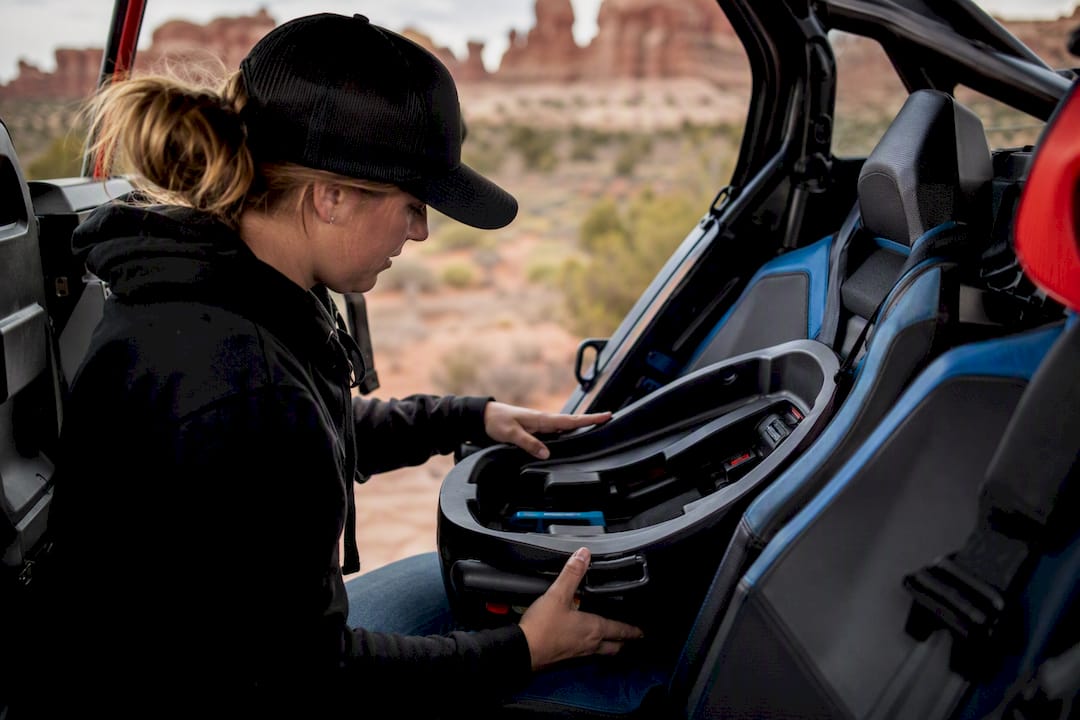
Watch for these red flags before you ever leave the lot: a base that rocks or lifts on one side, a shoulder belt crossing the neck instead of the collarbone, a seat installed by looping straps around a roll bar or seat seam it wasn’t designed to anchor to, and any tether routed across a sharp edge or bracket that could fray the webbing over a bumpy trail.
Pro Tip: If you’re torn between forcing a car seat install and just picking a gentler trail, take the gentler trail. A slower, guided route with a properly buckled child beats a technically-installed seat on terrain that’s rougher than the seat was ever tested for.
What to Ask Before You Book With Kids
A five-minute phone call before you book saves a frustrating morning at pickup. Ask the rental or tour company these questions directly:
- Will staff physically install a car seat, and have they done it before on the model you’ll be driving?
- How much extra time should you plan for at check-in to get the seat installed correctly?
- What’s the seating layout, bucket seats or bench, and does every seating position have a functioning belt?
- What are the insurance and damage-deposit options, and does the rental waiver mention anything specific about child passengers?
- Which trails does the company recommend for families, and is a guided tour available instead of a self-drive rental?
- If the vehicle can’t accommodate your seat safely, what’s the alternative, a different vehicle, a guided slow route, or a refund?
That last question matters more than parents expect. Some fleets simply don’t have a UTV model where a particular car seat will sit securely, and a company willing to say so upfront, rather than let you find out on the trail, is the one worth booking with.
| Ask this | Why it matters |
|---|---|
| Installation help available? | Confirms staff can fit your seat instead of leaving you to guess. |
| Bucket or bench seating? | Determines whether your seat’s base will sit flat and stable. |
| Insurance and deposit terms? | Clarifies your financial exposure if anything is damaged. |
| Family trail options? | Matches trail difficulty to what’s realistic with kids aboard. |
| Refund if seat won’t fit? | Protects you if the vehicle can’t safely accommodate your car seat. |
Why Epic4x4adventures Fits the Family-Ready Checklist
Every question on that checklist has a direct answer with Epic4x4adventures, which is exactly the point of running through it before you book anywhere in Moab.
- Fleet: brand-new 2026 Polaris RZR vehicles with built-in GPS navigation, available for both guided and self-drive experiences.
- Installation support: staff assist with car seat installation, and local guides lead family tours on terrain suited to kids rather than expert-only routes.
- Financial protection: an optional $0 damage-deposit choice removes one of the biggest stress points parents mention when renting off-road vehicles with children in the car.
- Track record: over 4,700 five-star reviews from riders who’ve already been through the booking and pickup process Epic4x4adventures runs today.
None of that replaces the need to check belt routing on your specific car seat. What it does is remove the guesswork from everything else, so the only variable left on pickup day is whether your seat fits the vehicle, and that’s a conversation the staff is set up to have with you.
Does Requesting Child Safety Help Cost More?
Most Moab rental and tour companies don’t charge extra just to install a car seat or answer questions about child restraints, since it’s a basic part of running a family-friendly operation. Where costs shift is around the accommodations themselves, not the safety conversation.

A guided family tour, versus a bare self-drive rental, typically costs more because you’re paying for a local expert behind the wheel and a route chosen for comfort over speed. That’s a trail-difficulty decision, not a child-safety surcharge. Damage-deposit policies can also affect your total cost. A refundable deposit ties up cash until the vehicle’s returned undamaged, while a $0 deposit option, where available, removes that upfront hit entirely.
Insurance add-ons are the other line item worth watching. Liability and medical coverage options exist specifically because off-road terrain carries real risk, and a family with young kids often has more reason to add that coverage than a solo adult rider does. It’s worth reading the fine print on what a rental deposit and insurance policy actually covers before assuming a lower quoted price includes the same protection.
Extra time for installation is free everywhere reputable. If a company tries to bill you simply for taking ten extra minutes to buckle in a car seat correctly, that’s a signal to call somewhere else.
Where to Book a Family-Friendly UTV Trip in Moab
Start with the vehicle and the route together, not separately. A modern fleet without a family-appropriate trail option doesn’t solve your problem, and neither does a gentle trail paired with an aging vehicle that lacks a workable belt path for your car seat.
Epic4x4adventures runs both sides of that equation from one Moab rentals page, where you can compare the 2026 Polaris RZR fleet against guided tour options built for riders of different ages and experience levels. If you’re planning the rest of a family trip around the UTV day, a broader family travel planning guide can help with the logistics outside the vehicle itself, packing, lodging, and pacing a multi-day trip with kids.
One more thing before you commit to a date: confirm which trails the tour actually uses. Motorized vehicles are barred from trails inside Arches and Canyonlands National Parks themselves, so any legitimate Moab UTV operation runs on designated public OHV trails or private land access outside park boundaries. A company that’s vague about where you’re actually driving is worth a follow-up question before you hand over a deposit.
The Real Gap in Most UTV Safety Advice
Most guidance on this topic stops at “check the law,” and that’s the problem. Utah’s statute governs public roads, and its OHV guidance for trails is deliberately open ended, which means the legal answer and the safety answer aren’t the same question. Parents who treat “it’s legal” as “it’s safe” are the ones most likely to skip the belt-path check that actually matters.
The conventional advice, matching your child’s age to a seat type, also falls short here. UTV seating geometry doesn’t care how old your kid is. It cares whether the belt runs where the seat expects it to. That’s a fit question, not an age question, and it has to be answered vehicle by vehicle.
If there’s one priority to take from this guide, it’s this: call the rental company before you show up, describe your exact seat, and ask a real person whether it has worked on their fleet before. That single call does more for your child’s safety than any statute on the books.
— PHENYX
Sources
Recommended
- Moab UTV Rentals: Prices, Requirements, and What’s Included | Epic 4x4
- 2-Seat vs. 4-Seat UTV in Moab: The Question Every Group Gets Wrong Before They Book | Epic 4x4
- UTV Rental Insurance in Moab: What You Actually Need to Know | Epic 4x4
- Can You Bring Your Dog on a UTV Tour in Moab? The Honest Answer | Epic 4x4