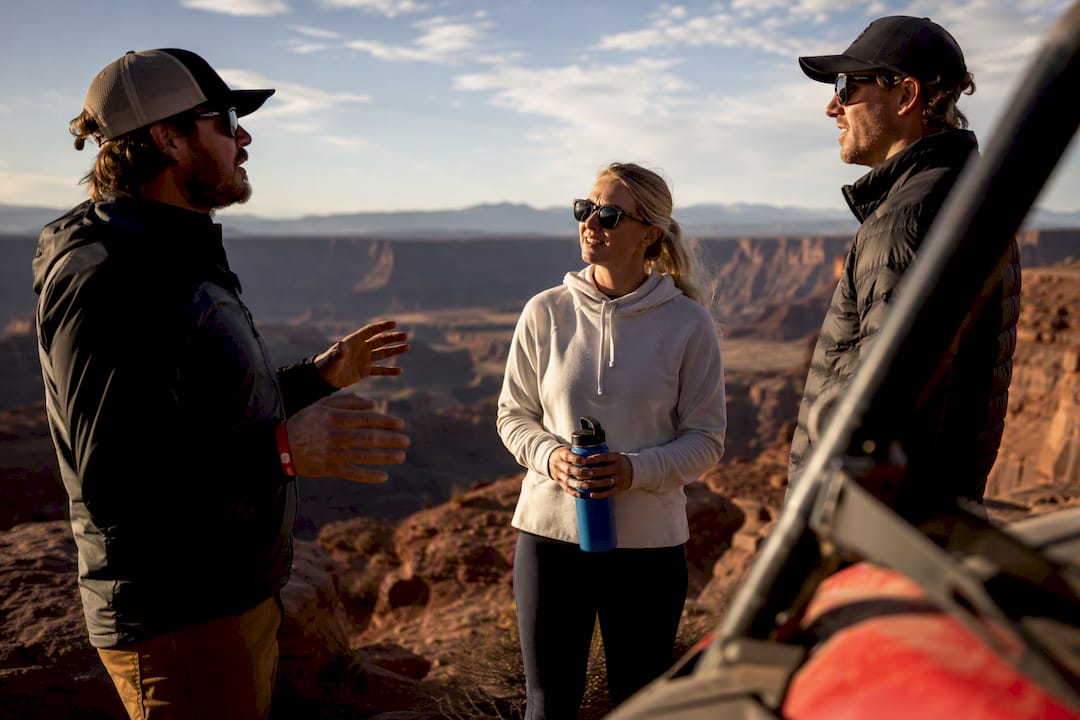
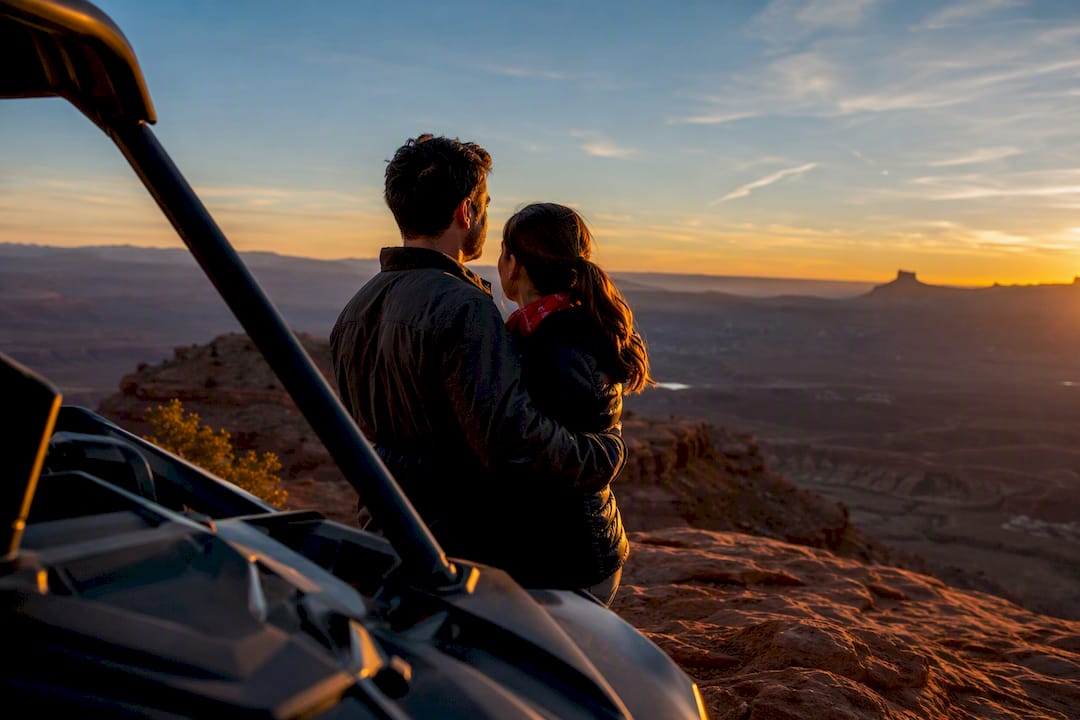
The default assumption in off-road tourism goes something like this: ATVs are the real off-road experience, side-by-sides are for people who want to pretend they're off-roading from a comfortable seat. Here's what actually happens when you put two or four people on a Moab trail: the ATV approach requires every rider to drive independently, every rider to have their own vehicle, and the group to spend the whole experience looking at the back of someone else's helmet. The side-by-side format isn't the safe choice—it's the social one. And on technical desert terrain, it's often the smarter one too.
What's Actually Different Between an ATV and a UTV
An ATV (all-terrain vehicle) is a single-rider vehicle you straddle like a motorcycle. A UTV (utility terrain vehicle), also called a side-by-side, seats two to five passengers in bucket seats with a roll cage, seatbelts, and a steering wheel. The footprint is larger, the stability is higher, and the experience is fundamentally different—you're inside the vehicle rather than perched on top of it.
For solo riders on narrow singletrack, an ATV has real advantages: it's lighter, more maneuverable in tight spaces, and weight distribution responds directly to rider input. In the Moab context, however, most of the trails that draw visitors aren't narrow singletrack. They're wide sandstone shelves, canyon-floor corridors, and technical rock gardens where vehicle stability matters more than width.
The Group Factor
This is where the UTV argument becomes nearly unanswerable for most visitors. If you're traveling with a partner, a family, or any group larger than one, ATVs mean splitting your party into separate vehicles operating independently. In a guided caravan format, that's manageable. In practice, it means coordinating multiple riders with varying skill levels across technical terrain—which adds logistical friction that most groups didn't sign up for.
A two-seat or four-seat UTV keeps your group together. Three generations can ride in a single vehicle. The person who's never driven off-road can ride as a passenger while someone more experienced takes the wheel. You can talk, point out canyon features, share the experience in real time instead of reconvening at pull-outs to debrief. For families in particular, that difference is substantial.
Safety and Stability on Desert Terrain
Moab's trails involve off-camber sections, steep descents, and sandstone surfaces that can grab or release traction without much warning. ATVs require active rider input to manage these transitions—if you're experienced, that's engaging. If you're a first-timer or an occasional rider, it introduces a margin for error that the UTV format largely removes.
UTVs at the level Epic 4x4 Adventures operates—Polaris RZR Pro R and Polaris Xpedition XP5 Northstar—feature six-point harnesses, roll cages, and factory safety systems that exceed anything a standard recreational ATV offers. The Xpedition's enclosed cab adds another layer of passive protection: in the event of unexpected weather, dust, or debris, occupants are shielded in a way that open ATV riding simply doesn't allow. The Pro R's performance suspension handles trail irregularities that would challenge a single-rider ATV to maintain clean line on.
Comfort on Technical Terrain
A half-day on the slickrock in an open ATV is one thing. A full day covering multiple trail systems is different. Dust exposure, sun fatigue, and vibration accumulate differently when you're straddling a vehicle versus sitting in a climate-controlled cab with stadium seating. Epic 4x4's Xpedition XP5 Northstar is specifically designed for longer-distance touring: the Northstar enclosed cab manages temperature, the suspension absorbs trail impact, and the preloaded GPS navigation lets drivers focus on the experience rather than route-finding.
For groups that include riders who aren't enthusiasts—who came for the scenery and the shared experience rather than the vehicle dynamics—the UTV format delivers the trail without demanding full-day physical output from every passenger.
When an ATV Actually Makes Sense
Solo riders with genuine technical riding backgrounds will sometimes prefer an ATV on specific singletrack routes. If you're a seasoned dirt bike or ATV rider looking for a physical, skill-intensive experience that puts maximum rider input into the equation, that preference is legitimate. It's a different category of experience than guided UTV touring—not a lesser one.
But for the majority of Moab visitors traveling in groups, mixing experience levels, and prioritizing scenery and the social dimension alongside vehicle dynamics—the UTV case closes itself quickly.
What Epic 4x4 Adventures Offers
Epic 4x4 Adventures operates an exclusively UTV fleet: the Polaris RZR Pro R for performance-focused riders who want the most capable machine on technical terrain, and the Polaris Xpedition XP5 Northstar for comfort and multi-passenger touring. Both vehicles operate in guide-led caravan format—you drive yourself with an expert guide setting the pace and handling trail navigation. The Adventure Assure protection plan covers mechanical and incidental concerns so your group can focus on the trail.
Tours range from the beginner-friendly Moab Slick Rock Discovery to the performance-oriented Pro Xperience. Browse the full tour catalog to find the right match for your group, or get in touch with specific questions about vehicle options and group sizing.
Frequently Asked Questions
Can beginners drive a UTV in Moab?
Yes. The drive-yourself guided caravan format Epic 4x4 Adventures uses is specifically designed for riders without prior off-road experience. Your guide sets the pace, explains each trail section before you enter it, and monitors the group throughout. The UTV's stability systems and enclosed cab reduce the skill threshold significantly compared to open ATV riding on technical desert terrain.
Do I need a driver's license to operate a UTV in Moab?
Yes. A valid driver's license is required for operators. Passengers of any age can ride without one. Epic 4x4 Adventures' age and licensing requirements are detailed on each individual tour page and confirmed at the time of booking.
Are UTVs faster than ATVs on Moab trails?
On open terrain, high-performance UTVs like the Polaris RZR Pro R are comparable in speed to performance ATVs. On the technical sandstone trails Moab is known for, speed matters less than vehicle stability and line selection. The UTV's wider stance and long-travel suspension often allow it to maintain smoother, more controlled lines on rocky sections than a single-rider ATV.
What is the difference between a side-by-side and a UTV?
The terms are interchangeable. "Side-by-side" refers to the seating configuration—passengers sit beside each other rather than fore and aft. "UTV" is the broader vehicle category. Both terms describe the same class of off-road vehicle that includes the Polaris RZR Pro R and Xpedition XP5 models operated by Epic 4x4 Adventures.