Yes. A UTV can be street-legal and driven on public roads in Moab if it meets Utah’s state equipment and registration standards under Utah Code §41-6a-1509, plus whatever the City of Moab layers on top through local ordinance. The City of Moab enforces its own speed and noise rules for street-legal off-highway vehicles (OHVs), and those rules got a refresh with Ordinance No. 2026-12. Operators also need to have completed the Utah OHV Education Course where required.
Before you turn a key or sign a rental agreement, carry these three things:
- Valid registration and license plate showing street-legal status
- Proof of insurance for the vehicle
- A valid driver’s license (and youth OHV education certificate, if applicable)
Key Takeaways
A street-legal UTV in Moab must satisfy Utah Code §41-6a-1509’s equipment and registration standards plus the City of Moab’s local speed and noise rules under Ordinance No. 2026-12.
| Point | Details |
|---|---|
| State law sets the baseline | Utah Code §41-6a-1509 defines required equipment, registration, and licensing for street-legal UTVs. |
| Moab adds local limits | Ordinance No. 2026-12 authorizes posted speed limits, with a 15 mph default on city streets. |
| Noise compliance is enforced | Vehicles exceeding the city’s dBA thresholds are barred from city streets regardless of plates. |
| Carry your paperwork | Registration, insurance, driver’s license, and OHV certificate should be on hand at all times. |
| Choose a compliant rental | Epic4x4adventures maintains a street-legal, registered fleet with staff walk-throughs and optional $0 deposits. |
This article is general information, not a substitute for advice from a qualified lawyer. Consult a qualified legal professional about your own circumstances before acting on anything here.
Table of Contents
- What “Street-Legal UTV” Means Under Utah Law
- Moab’s 2026 Ordinance: Speed Limits, Noise Rules, and Where You Can Actually Drive
- Driver Requirements and Paperwork You Need in Moab
- How to Check If a UTV Is Actually Street-Legal in Under Five Minutes
- Renting a UTV vs. Bringing Your Own: Who Confirms What
- What Happens If You Get It Wrong: Enforcement and Penalties
- Two-Minute Pre-Drive Checklist and Who to Call
- A Local View on Street-Legal Compliance
- Skip the Guesswork With a Compliant Rental
- Sources
What “Street-Legal UTV” Means Under Utah Law
Utah Code §41-6a-1509 is the statute that decides whether your UTV can legally touch a public road. It governs which off-highway vehicles qualify as street-legal, what registration they need, and what equipment has to be bolted on before the state considers them roadworthy.
The equipment list isn’t complicated, but skipping a single item disqualifies the vehicle. A street-legal UTV in Utah generally needs:
- Headlights and taillights
- Turn signals and a horn
- Rearview mirrors
- Brakes beyond a simple parking brake
- A muffler or noise-suppression system
- An illuminated license plate light
Once equipped, the vehicle gets registered and titled much like a passenger car, which matters for both licensing and insurance. The driver needs a valid driver’s license, and Utah requires OHV operators to complete the Utah Off-Highway Vehicle Education Course, with a mandatory youth certificate for anyone under 18.
Utah Code §41-6a-1509 doesn’t just list equipment. It draws the legal line between an OHV you trailer to a trailhead and one you’re allowed to drive there yourself, and that distinction is worth memorizing before you ever load up.
Pro Tip: Check the Utah Non-Resident OHV Permits FAQ page before you travel. It’s the fastest way to confirm whether your OHV education certificate and home-state plates will actually hold up in Utah.
Moab’s 2026 Ordinance: Speed Limits, Noise Rules, and Where You Can Actually Drive
State law sets the floor. The City of Moab sets the ceiling, and that ceiling changed in 2026.
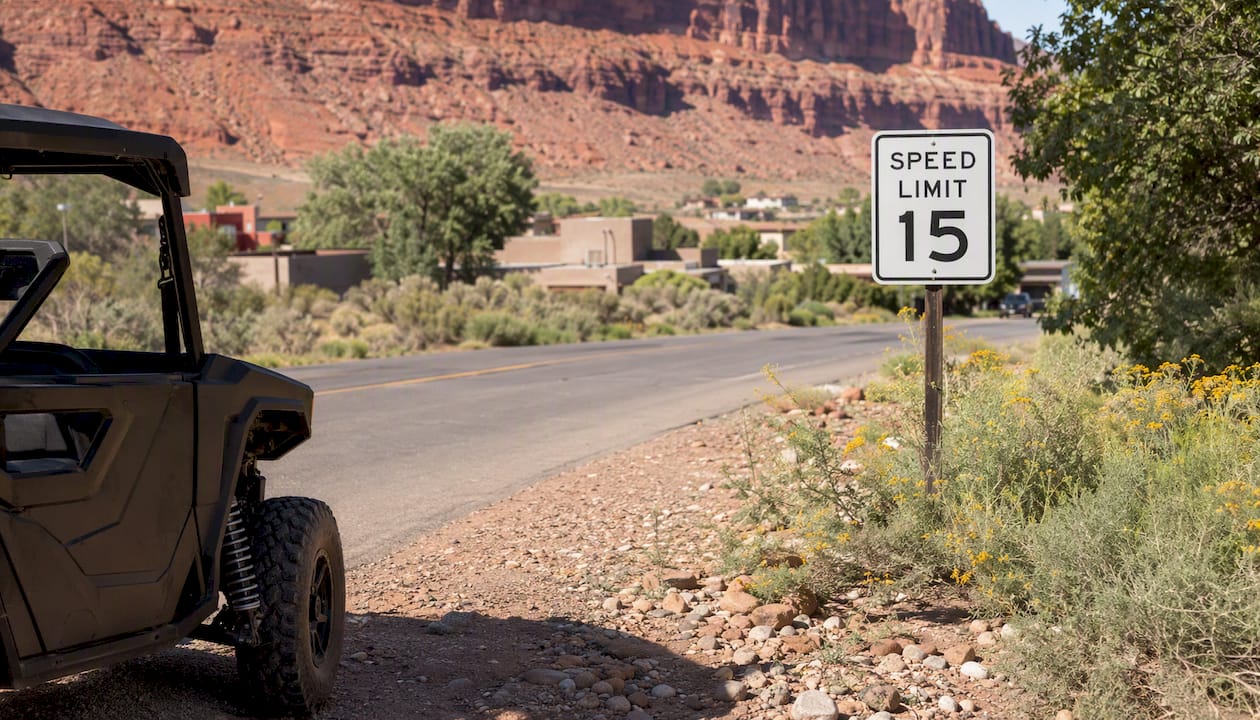
The City of Moab’s official OHV guidance requires street-legal OHVs to obey a default designated speed limit on posted city streets, well below the standard 25 mph most residential roads carry for cars. On June 9, 2026, the Moab City Council adopted Ordinance No. 2026-12, which repealed the older 2020-15 ordinance and rewrote the city’s approach to speed enforcement for street-legal vehicles. The new ordinance gives the City Engineer and City Council authority to post specific speed limits on individual streets, rather than relying on a single blanket number citywide.
Noise gets just as much attention as speed. The city’s guidance lists decibel (dBA) thresholds tested with a stationary methodology, and vehicles that exceed those limits aren’t allowed on city streets regardless of how well-lit or plated they are. A UTV can be perfectly legal on paper and still get turned away if its exhaust runs too loud.
What this looks like in practice: expect posted signage near trailhead access roads and residential streets bordering popular staging areas, where noise complaints tend to concentrate. Streets that connect directly to trail systems are the most likely spots to see a posted limit below the citywide default.
Pro Tip: Ask your rental company directly whether their fleet has passed a stationary noise test and whether posted limits apply on the route you’re planning. Local staff usually know which streets draw the most enforcement attention.
Driver Requirements and Paperwork You Need in Moab
Getting behind the wheel legally in Moab comes down to two things: who’s allowed to drive, and what they need to prove it.
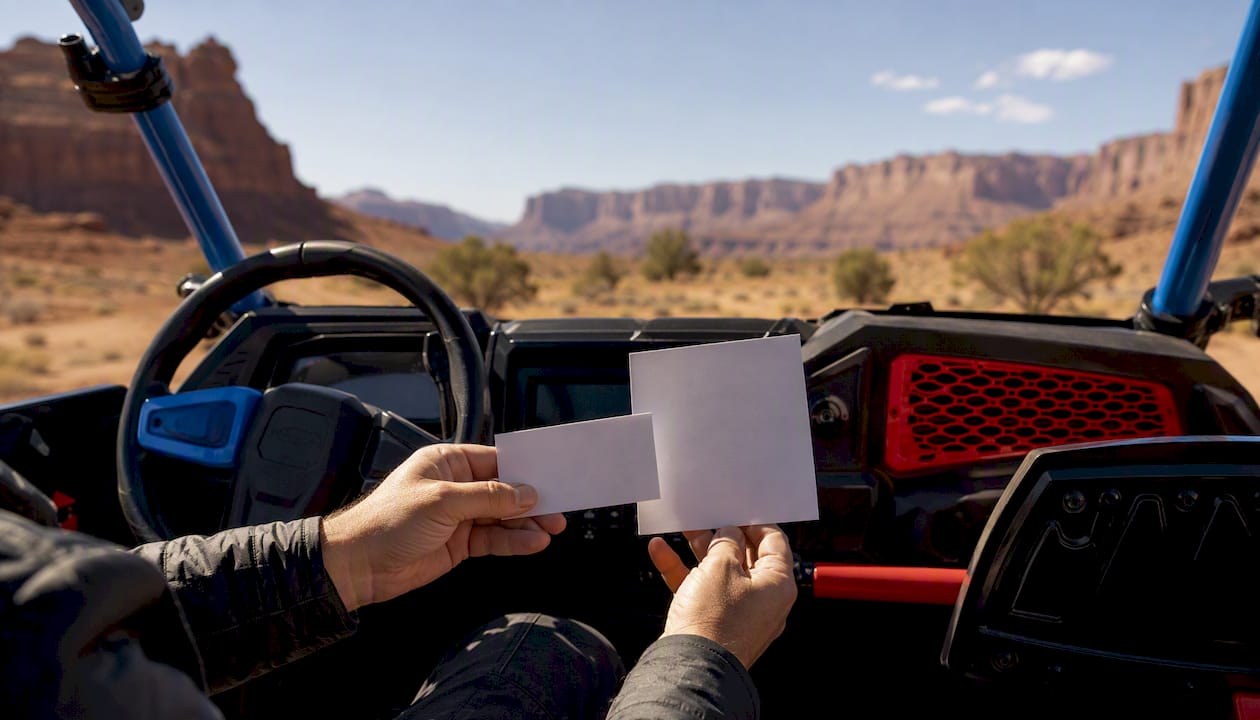
Utah requires a valid driver’s license to operate a street-legal UTV on public roads, and anyone under 18 needs a youth OHV education certificate on top of that. Adults benefit from completing the Utah OHV Education Course as well, since some rental companies and trail permits ask for it.
Documents to keep on hand at all times:
- State registration and license plate
- Proof of insurance
- Driver’s license
- OHV education certificate (required for youth operators)
Visiting from out of state? The rules get more nuanced. According to Utah’s non-resident OHV guidance, a machine that’s already registered and plated as street-legal in its home state, and meets Utah’s equipment standards, may not need a separate non-resident OHV permit for road use. Trail use is a different story and often does require that permit. If your home state doesn’t plate OHVs at all, plan to trailer your vehicle rather than assume Utah will treat it as street-legal.
When renting, ask to see the registration and plate before you sign anything. A quick glance confirms the vehicle is titled for street use rather than trail-only.
Pro Tip: Snap photos of your registration, insurance card, and OHV certificate before you leave home. Having them on your phone saves time if a city officer or trailhead attendant asks.
How to Check If a UTV Is Actually Street-Legal in Under Five Minutes
A quick walk-around tells you almost everything you need to know.
- Check for working headlights, taillights, and an illuminated plate light.
- Confirm turn signals and a horn are present and functional.
- Look for mirrors on both sides and a visible speedometer.
- Verify the vehicle has a mounted license plate, not a temporary tag or none at all.
- Ask to see the registration paperwork and confirm it lists the vehicle as street-legal, not off-highway only.
- Ask about the vehicle’s noise test status and any known posted speed restrictions on your planned route.
If any of these are missing, treat that as a hard stop. Beyond the visual check, confirm the paperwork:
- Registration type (street-legal vs. trail-only)
- Proof of insurance covering the rental
- OHV education certificate for youth operators
Aftermarket lights or a fresh coat of paint don’t make a UTV street-legal. Actual compliance requires meeting the statutory equipment list and, in most cases, a formal registration change through the DMV. If a rental company can’t produce a registration or insurance document on request, don’t drive it on city streets. That’s the simplest rule in this entire guide.
Renting a UTV vs. Bringing Your Own: Who Confirms What
Renters and owners carry different responsibilities, and mixing them up is how people end up with an unplanned fine.
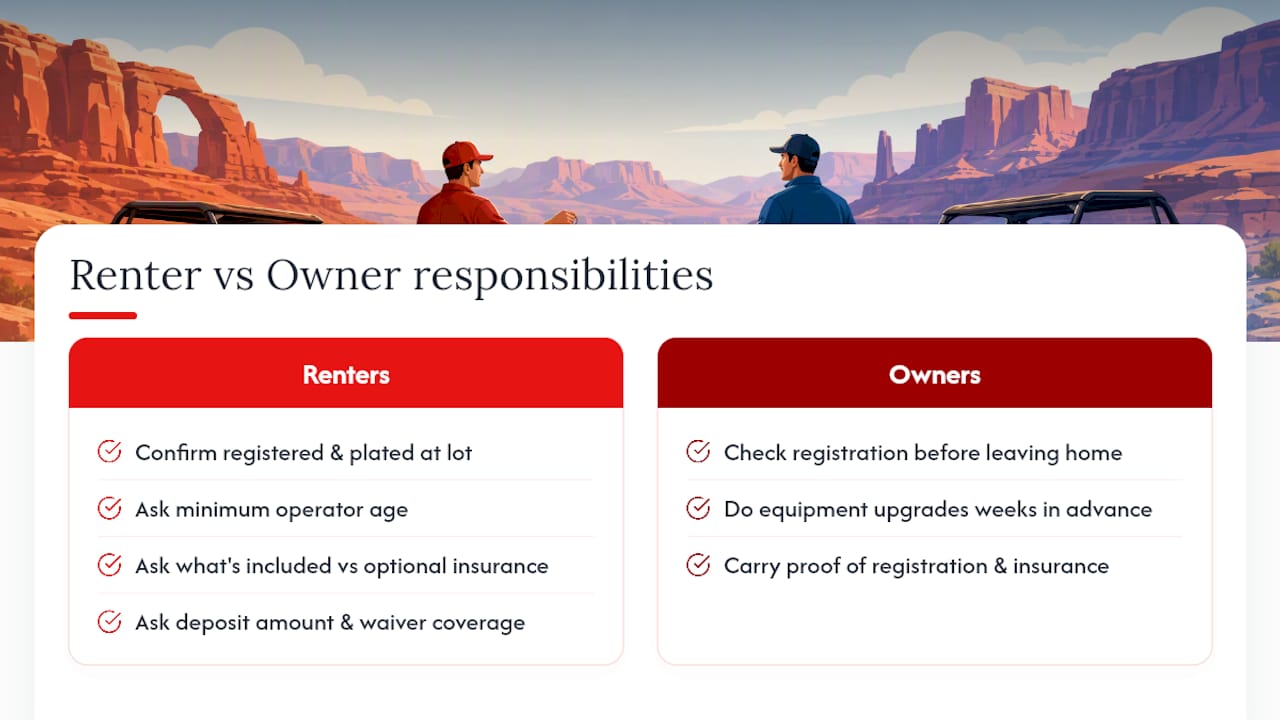
If you’re renting, confirm the vehicle is registered and plated for street use before you drive off the lot. Ask about minimum operator age, what insurance is included versus optional, and what the deposit and damage waiver actually cover. Our rental requirements guide walks through exactly what to expect.
If you’re bringing your own UTV, do your registration check before you leave home, not after you arrive. Equipment upgrades like turn signals or mirrors often need to happen weeks in advance, and carrying proof of your home state’s registration and insurance saves a headache at any checkpoint.
Epic4x4adventures maintains its fleet to meet Utah’s street-legal registration and equipment standards as a baseline, not an upsell.
Pro Tip: Ask for a staff walk-around before you drive off. A five-minute equipment tour, plus a direct contact number, means you’re never guessing if a question comes up mid-trip.
What Happens If You Get It Wrong: Enforcement and Penalties
The most common violations in Moab are straightforward: an unplated UTV on a city street, a vehicle running faster than the posted OHV limit, or one that fails the city’s noise threshold.
Consequences scale with the violation. A first-time visitor with a paperwork gap often gets a warning. Repeat or more serious violations, like consistently ignoring posted limits, can bring fines or a requirement to trailer the vehicle out. Enforcement tends to follow resident complaints about noise or speed near trailheads rather than routine patrol stops, so documentation matters more than you’d think.
Pro Tip: If you’re stopped, cooperate and hand over your paperwork. Arguing on the spot rarely helps. If you believe an error was made, follow up with the city or DMV afterward using your photographed documents as evidence.
Two-Minute Pre-Drive Checklist and Who to Call
Before you pull onto any Moab street, run through this list:
- Plate and registration visible and current
- Proof of insurance on hand
- Lights, turn signals, and horn functioning
- Muffler and noise compliance confirmed
- Driver’s license (and OHV education certificate for youth operators) ready to show
If something’s unclear, bookmark the City of Moab’s OHV guidance page for speed and noise rules, keep Utah’s OHV education site handy for certificate questions, and save your rental company’s direct line for on-the-spot equipment or paperwork questions.
A Local View on Street-Legal Compliance
We built our rental process around one idea: compliance shouldn’t be the guest’s job to figure out alone. Every UTV in our fleet is maintained to meet Utah’s registration and equipment standards before it ever leaves the lot, and our staff walks each renter through the paperwork and equipment during pickup.
Guests get a registered, street-legal vehicle, optional insurance coverage, a staff-led walk-through, and in many cases a $0 damage-deposit option. Booking a compliant rental means you spend your day on the trail instead of worrying about whether your plate light works.
Skip the Guesswork With a Compliant Rental
Reading statutes and city ordinances is one way to figure out if your UTV can legally hit Moab’s streets. Booking with a company that already handles compliance is the faster route.
Epic4x4adventures runs a fleet of new 2026 Polaris vehicles that meet Utah’s street-legal registration and equipment standards from the start, so you’re not stuck double checking turn signals or hunting for a plate light before your trip. Every rental comes with built-in GPS navigation for the trails around Canyonlands and Arches, and guests can choose a self-drive rental or a guided tour led by someone who already knows which streets carry posted limits. Our optional $0 damage-deposit rentals and included liability coverage mean less paperwork stress on your end, not more.
Check availability and book a street-legal UTV rental directly, or browse our guided tours if you’d rather let a local expert handle the driving and the rules.
Sources
- OHVs In Moab | Moab, UT - Official Website
- Utah Non-Resident OHV Permits FAQs - Utah Outdoor Recreation
Recommended