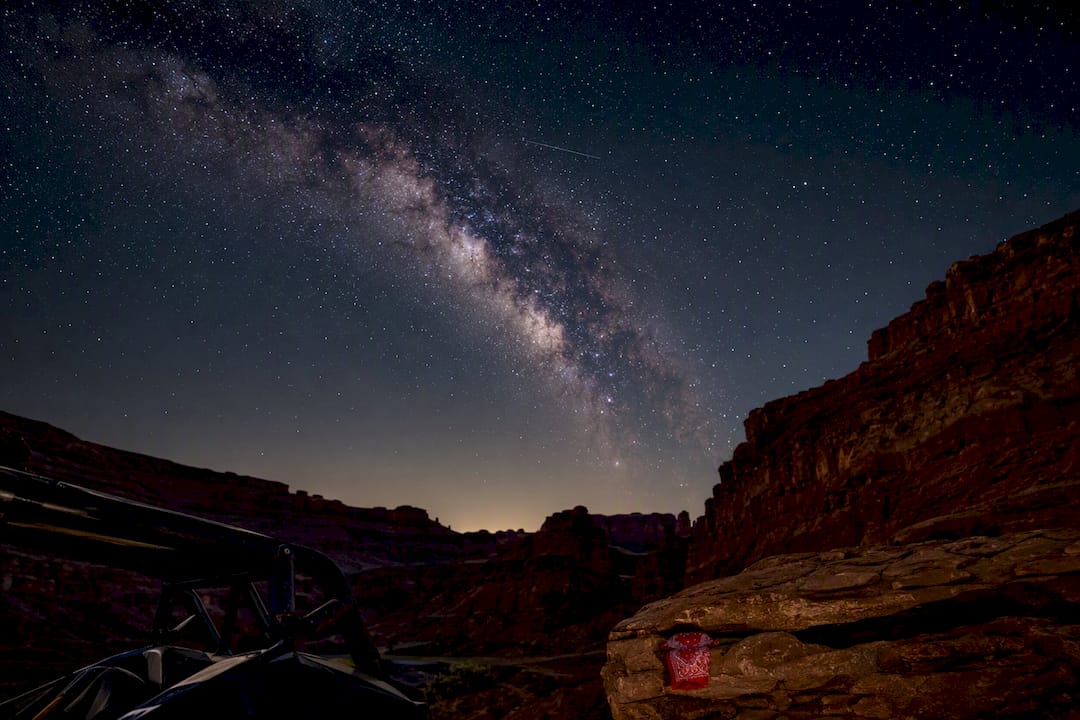
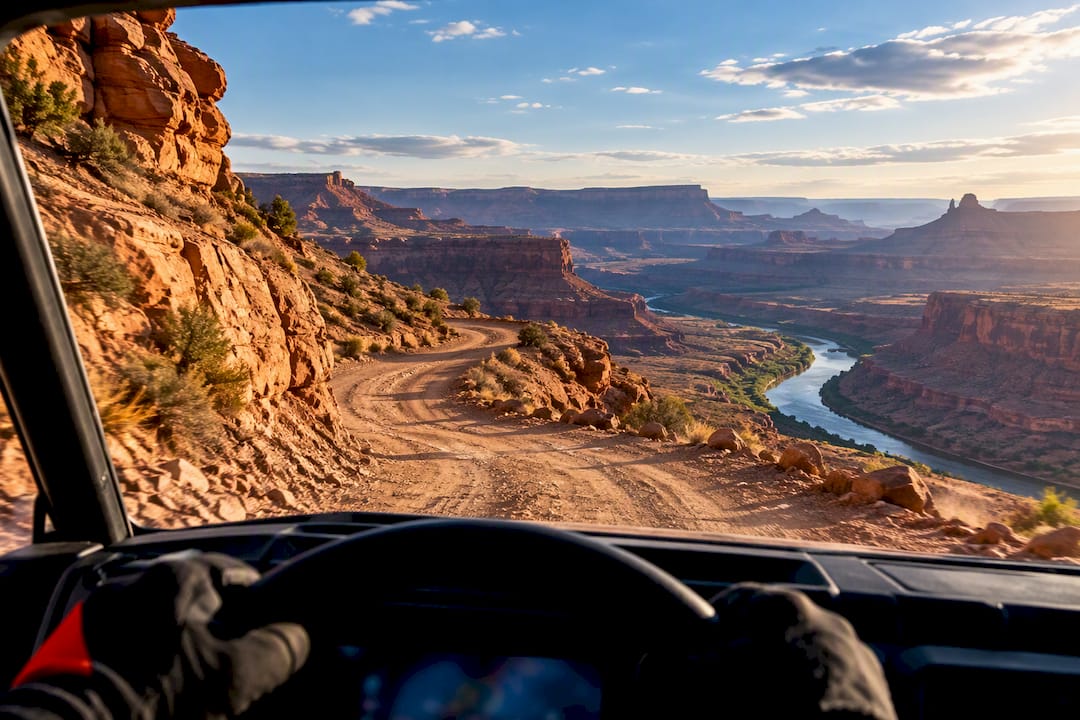
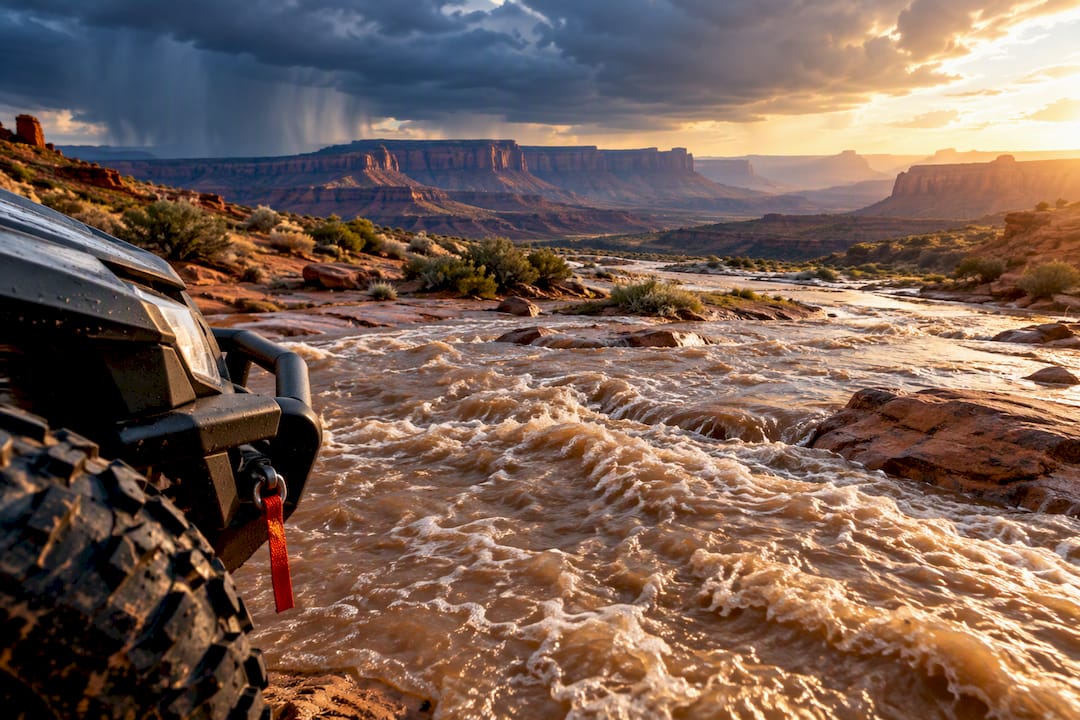
Arches, Canyonlands, and Dead Horse Point deliver the darkest, clearest Milky Way views near Moab, but here’s the rule that changes your plan: UTVs are not allowed inside any of the three parks. You’ll need to view on foot once you’re inside park boundaries, or ride BLM-designated motorized routes outside them, or book a guided UTV tour that handles the logistics for you. Whichever route you pick, check the moon phase and park hours before you leave the driveway.
TL;DR:
- UTVs are prohibited inside Arches, Canyonlands, and Dead Horse Point parks, requiring visitors to view on foot, on designated routes, or with guided tours.
- The best stargazing spots have official dark-sky recognition, with Arches, Canyonlands Island in the Sky, and Dead Horse Point offering the clearest views of the Milky Way.
- Optimal viewing occurs during March to July and September to November, on a new moon or when the moon sets early, with clear skies essential for seeing the Milky Way visually.
- Guided UTV tours ensure legal access and better route planning, with vehicles equipped with navigation and trips starting around $259 to $396.
- Always confirm park hours, closures, and ranger programs before heading out and remember to keep headlights off after parking to preserve night vision.
Table of Contents
- Best Dark-Sky Viewing Spots Near Moab
- UTV-Accessible Trails and Staging Areas for Night Viewing
- When to Go for the Best Milky Way Views
- Rules, Safety, and Etiquette After Dark
- Stargazing and Photography Tips for UTV Trips
- Why Local Guides Often Beat a Solo Night Run
- Book a Guided Route to Moab’s Darkest Skies
- Sources
- FAQ
Best Dark-Sky Viewing Spots Near Moab
All three of the region’s marquee stargazing sites carry official dark-sky recognition, which is a bigger deal than it sounds. It means someone has measured the light pollution and confirmed the sky above these places is genuinely unspoiled.
Arches National Park earned its International Dark Sky Park status in 2019, and the park backs that designation with nearly all its fixtures converted to night-sky friendly lighting. Garden of Eden, Balanced Rock, and Panorama Point are the go-to viewpoints for a reason: open horizons, minimal ambient glow, and enough elevation to pull the Milky Way’s core above the surrounding rock.
Canyonlands National Park, recognized around the same era, saves its best views for Island in the Sky. The mesa-top viewpoints there give you a full 360-degree horizon, which matters more for Milky Way viewing than most people realize. A tall canyon wall on one side can block a third of the sky you came to see. Canyonlands also runs ranger-led night programs seasonally, typically spring through fall.
Dead Horse Point State Park, recognized as an International Dark Sky Park in 2016, sits on a plateau overlooking the Colorado River gooseneck. That elevation gives it one of the cleanest 360-degree skies in the region. The park distributes a dark-sky brochure covering practical prep, and rangers run night-sky programs worth building a trip around.
- Arches: Garden of Eden, Balanced Rock, Panorama Point
- Canyonlands: Island in the Sky viewpoints
- Dead Horse Point: plateau overlooks near the visitor center
UTV-Accessible Trails and Staging Areas for Night Viewing
BLM land is where UTVs actually belong after dark. The Moab Field Office motorized travel map marks designated routes and staging points across the public land ringing Moab, and that’s the legal playground for night riders. Inside Arches or Canyonlands boundaries, UTVs are off limits entirely, no exceptions for a quick photo run.
A few staging areas come up again and again among riders looking for dark, open sky near legal motorized access:
- Poison Spider Mesa trailhead, with wide slickrock overlooks a short distance from parking.
- Kane Creek and Gemini Bridges trailheads, both feeding into extensive BLM route networks.
- Moab Rim staging areas, popular for their elevation and river-canyon views.
- Porcupine Rim pullouts, which offer some of the widest open sky in the immediate area.
Many of the best panoramic spots require a short walk from your parked UTV rather than a drive to the literal rim, so plan for that last quarter mile on foot. Park outside the white highway line at any trailhead, and respect posted capacity limits. Trailer parking fills up fast on clear weekend nights.
Pro Tip: Stick to the marked route even when a shortcut looks obvious under headlights. Biological soil crusts take decades to recover from a single set of tire tracks, and cutting across them can also disturb culturally significant sites you can’t see in the dark.
When to Go for the Best Milky Way Views
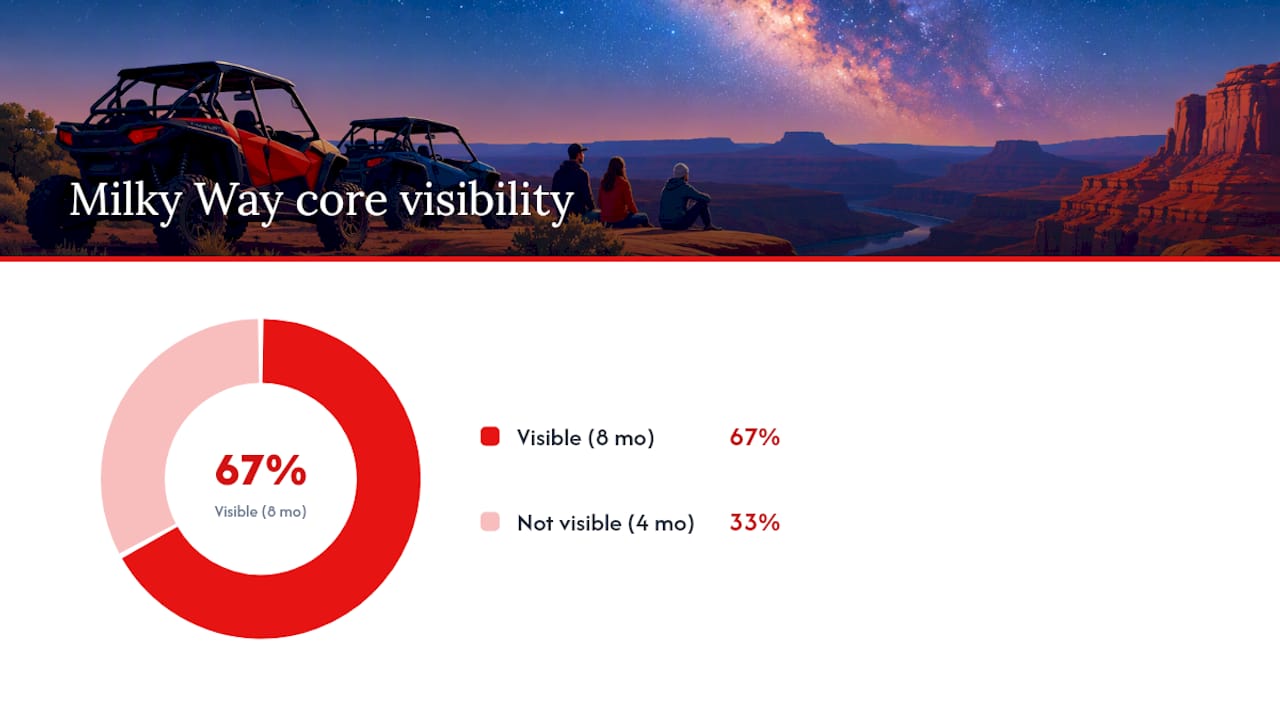
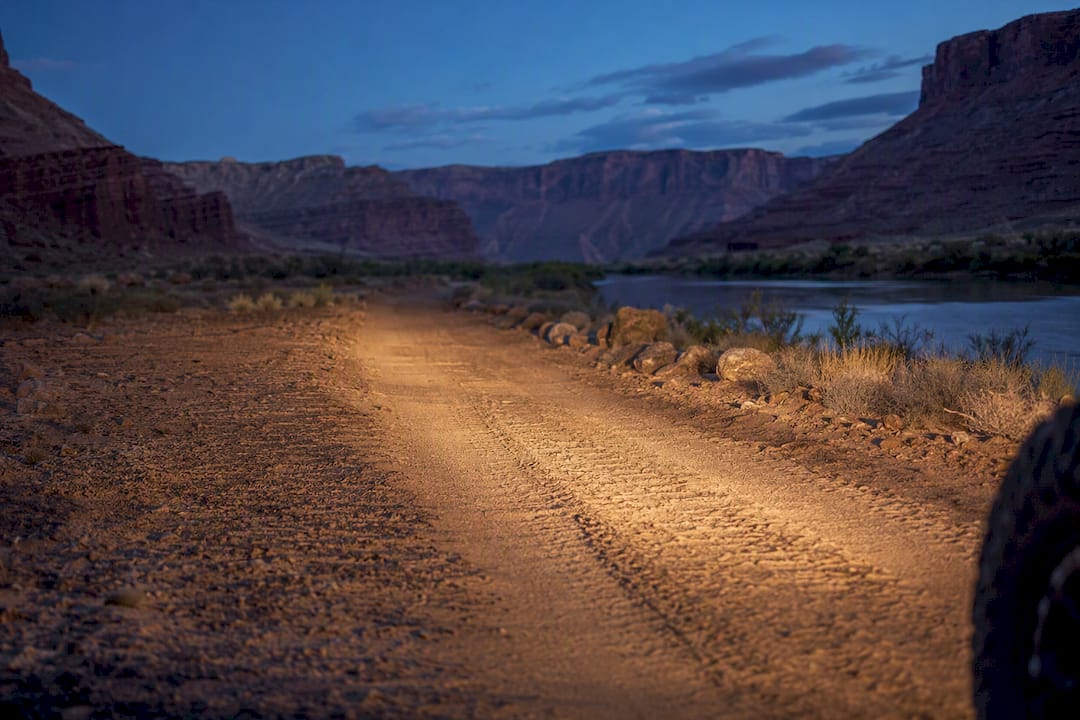
Timing beats location if you get it wrong. The Milky Way’s core is visible in evening hours mainly during two windows: March through July and September through November. Outside those windows, the core sits below the horizon during convenient viewing hours.
Moon phase matters just as much as season. Canyonlands rangers recommend visiting during a new moon or on nights when the moon sets early, since even a thin crescent washes out the faint dust lanes that make the Milky Way striking. Before you commit to a night, check:
- The park’s clear-sky forecast or a regional clear-sky chart
- DiscoverMoab or a local weather service for cloud cover
- The moonrise and moonset time for your target date
A new moon night with clear skies is genuinely the difference between seeing a faint smudge and seeing the Milky Way’s structure with the naked eye.
Rules, Safety, and Etiquette After Dark
Arches and Canyonlands prohibit OHVs and UTVs inside park boundaries, full stop. That rule doesn’t bend for stargazing trips, even if you’re only planning to park and walk in. Dead Horse Point’s IDA status comes with its own closure schedule and ranger oversight, though campers staying overnight often get extended access to viewing areas after gates close to day visitors.
Your legal night-riding options are BLM motorized routes, staying at a campground with vehicle access, or joining a permitted guided tour. A basic safety checklist for any of these:
- Red lights only once your eyes have adjusted
- Warm layers, since desert nights drop fast even after a hot day
- Basic recovery gear in case a tire finds a rut in low light
- Pack out everything, and never move rocks or build cairns at staging areas
Pro Tip: Keep your headlights off once you’ve parked and started dark adaptation. One swinging beam from a UTV can undo twenty minutes of night vision for everyone around you, not just your own group.
Stargazing and Photography Tips for UTV Trips
Give your eyes 20 to 30 minutes to fully dark-adapt before you judge how good the sky actually looks. A single glance at a white phone screen resets that clock instantly, which is why red lights are standard practice among serious stargazers.
For photos, a wide-angle lens, high ISO, and a 15 to 25 second exposure will capture far more of the Milky Way than your eyes alone can see. Set your tripod up from a legal staging area rather than hiking it out to a fragile rim edge for a marginally better angle.
- Bring blankets or a reclining chair for comfort during long sessions
- Pack binoculars and a planisphere or stargazing app for orientation
- Frame shots around durable foregrounds like distant mesas, keeping a respectful distance from arches and delicate features
Why Local Guides Often Beat a Solo Night Run
A guided UTV tour strips out the two biggest risks of a night outing: getting the regulations wrong and getting lost on unfamiliar routes after dark. Local guides already know which pullouts are legal, photogenic, and low-impact, so they stage vehicles accordingly. That said, independent riders who study the BLM motorized map and plan carefully can absolutely have a great night out on their own.
— PHENYX
Book a Guided Route to Moab’s Darkest Skies
A guided UTV tour removes some of the uncertainty of night-riding rules, as guides often know which BLM staging areas and pullouts offer legal, photo-ready sky views. That local knowledge matters more after dark than it does at noon, when a wrong turn is a minor inconvenience instead of a real problem.
Every tour runs on new 2026 Polaris vehicles with built-in navigation, so you’re not relying on a phone signal that may not exist out on the mesa. Rentals start at $259 to $396 if you’d rather scout daylight routes yourself before a night trip, and guided options like the Moab Discovery Tour run $329 per vehicle with a local expert handling the route planning. A $0 damage deposit option takes one more worry off the table. Check current tour dates and book your spot on the tours page before the clear, moonless nights on your calendar fill up.
Sources
Confirm hours, closures, and ranger program schedules directly with the source before any night outing. The Arches stargazing page covers viewpoint recommendations and lighting rules, the Canyonlands stargazing page lists seasonal ranger programs, Dead Horse Point’s night-sky page details its dark-sky brochure and events, and the BLM Moab motorized travel map shows every legal UTV route and staging point in the field office’s jurisdiction.
- Stargazing - Arches National Park (U.S. National Park Service)
- BLM Moab Field Office motorized travel map
FAQ
When Can You See the Milky Way in Moab, Utah?
The Milky Way’s core is visible in evening hours mainly from March through July and again from September through November. Aim for a new moon or a night when the moon sets early, since even a slim crescent washes out fainter detail.
Where Is the Best Place to Stargaze in Moab, Utah?
Arches, Canyonlands, and Dead Horse Point are the top three, each holding International Dark Sky Park recognition. Inside Arches, Garden of Eden, Balanced Rock, and Panorama Point are the most recommended viewpoints for their open horizons and minimal light interference.
What Are the Best Side-by-Side Trails in Moab?
For legal night access by UTV, BLM routes around Poison Spider Mesa, Kane Creek, Gemini Bridges, and Moab Rim are the most commonly used staging areas. Readers who’d rather skip route planning entirely can book a guided tour like Epic4x4adventures’s Moab Discovery Tour, which pairs a Polaris UTV with a guide who already knows the legal, photo-friendly pullouts.
Is Potash Road Worth It?
Potash Road offers scenic canyon and river views along a paved and graded route, and it’s a reasonable daytime drive for scouting future night spots. It’s not one of the primary dark-sky viewpoints covered by park ranger programs, so pair it with a trip to Dead Horse Point or Canyonlands for the actual stargazing.
Recommended